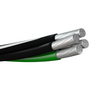
2/0-2/0-2/0-1 Aluminum Mobile Home Feeder Direct Burial Cable 600V
Allowable Ampacity for 2/0-2/0-2/0-1 Aluminum Mobile Home Feeder Cable: 150 Amps
Applications:
Aluminum Mobile Home Feeder cable is a service entrance cable for mobile homes. The cable is approved according to the National Electric Code. The maximum operating temperature is 90°C in wet and dry locations. The voltage rating is 600 volts.
Also Known As:
2/0-2/0-2/0-1 aluminum cable, 2/0-2/0-2/0-1 aluminum wire, 2/0-2/0-2/0-1 mobile home feeder cable, 2/0-2/0-2/0-1 underground feeder cable, 2/0-2/0-2/0-1 service entrance cable, 2/0-2/0-2/0-1 electrical feeder cable, 2/0-2/0-2/0-1 power feeder cable.
Standards:
Ampacities based on National Electric Code, 2005n edition, section 310-15
National Electric Code (NEC)
UL 44 for types RHH & RHW-2
UL 854 for type USE-2
ASTM standards B 800, B 801
Sunlight resistant
RUS ACCEPTED
Construction:
Conductors:
Aluminum home feeder cable has a compact stranded soft drawn 8000 series aluminum conductor in accordance with ASTM B-800 or B-801. The conductor is the electrode in the cable and is responsible for transmitting electric current.
Insulation:
It has cross-linked polyethylene (XLP) insulation. The conductors are normally cabled together with XLP insulated aluminum ground or bare copper ground and covered with reinforced binder tape. XLP insulation is tough and resistant to impact, abrasion, chemicals, acids, oils, industrial solvents, and changes in weather.
*Data provided on this page is subject to change based on different manufacturers' variances
** Images are for display purposes only refer to Product Technical Details for accurate information on the product.
In the case the material only comes in a predetermined color or doesn’t come with any color
Recently Viewed Products
Download PDF Spec Sheet
FAQ's
What does 2/0-2/0-2/0-1 AL MHF mean?
Two 2/0 AWG aluminum hot conductors, one 2/0 AWG aluminum insulated neutral, and one #1 AWG aluminum insulated equipment grounding conductor. All four conductors are individually insulated, rated 600V, with USE-2 or XHHW-2 insulation.
What is Mobile Home Feeder (MHF) cable?
A 4-conductor aluminum cable for feeding power from a service panel to a mobile or manufactured home. Modern MHF uses USE-2 or XHHW-2 conductor insulation, both listed for direct burial and wet locations. The "four conductor, all insulated" construction sets it apart from standard SER, which usually has a bare ground.
What amp rating does 2/0-2/0-2/0-1 aluminum MHF support?
For a residential dwelling service or main power feeder to a dwelling, 2/0 aluminum with a full-size neutral is rated for 175A under the reduced-sizing allowance in NEC 310.12. For non-dwelling applications, the standard 75°C ampacity from NEC 310.16 applies: 2/0 AWG aluminum is rated 135 to 150A at 75°C depending on termination temperature. The full-size 2/0 neutral makes this cable suitable for full-load feeders where the neutral may carry unbalanced current.
Is 2/0-2/0-2/0-1 MHF cable rated for direct burial?
Yes. The individual conductors inside standard MHF are USE-2 or XHHW-2, both listed for direct burial in wet locations. Follow NEC 300.5 for burial depth: 24 inches for direct-buried residential feeders under 600V, 18 inches under a concrete slab, and shallower depths where protected by conduit.
What is the difference between MHF and SER cable?
Two main differences. MHF has an insulated ground; standard SER has a bare ground. And MHF is rated for direct burial and wet locations because it uses USE-2 or XHHW-2 conductors; SER is not. Both are 600V and both are commonly aluminum. Use MHF when the run will be underground or when the destination requires a separated ground and neutral all the way to the subpanel.
Can I use MHF cable to feed a pole barn or detached garage?
Yes, and this is one of the most common non-mobile-home uses. MHF gives you the four insulated conductors NEC 250.32 requires, along with a direct-burial rating. Size the cable for load and run length, install a grounding electrode at the outbuilding, and keep neutral and ground separated at the subpanel. 2/0-2/0-2/0-1 handles loads up to 175A over runs to about 175 ft before voltage drop becomes the limit.
Can I use MHF cable overhead as an aerial run?
Not as an unsupported drop. For an overhead span between buildings, MHF needs proper messenger support per NEC 396, or it needs to run inside conduit strung between the buildings. Triplex or quadruplex URD is more commonly used for aerial residential drops because it comes pre-assembled with a messenger.
What is the difference between MHF and URD cable?
Both are direct-burial rated and both use USE-2 or XHHW-2 conductors. The difference is construction. URD typically comes as triplex or quadruplex with a bare aluminum messenger neutral wrapped around the phase conductors; it is the utility-style assembly used for aerial service drops and buried residential feeders. MHF has all four conductors fully insulated with no bare messenger. Use URD where a bare concentric neutral is acceptable. Use MHF where NEC 250.32 requires an insulated neutral and a separate insulated ground.
How far can I run 2/0-2/0-2/0-1 MHF for 175A service?
Voltage drop, not ampacity, is the sizing limit at long distances. Rule of thumb for a 175A load on 2/0 aluminum at 240V single phase, keeping voltage drop under 3%: about 130 to 150 ft. Beyond that, upsize to 4/0 aluminum. Do the actual voltage-drop calculation for the specific load and run length before ordering.
What voltage drop should I expect on 2/0-2/0-2/0-1 aluminum MHF?
At 175A load, 240V single phase, on 2/0 aluminum, expected voltage drop is roughly 3% at 150 ft, 5% at 245 ft, and 7% at 340 ft. Standard practice keeps total voltage drop (feeder plus branch circuits) under 5%, with the feeder itself under 3%. Use a proper calculation with the actual load current before ordering.
 Garrie AI: Your Cable Guide