Garrie AI: Your Cable Guide


Garage Electrical Installation: A Complete Guide
Garage electrical installation starts with one question: what will the garage actually need to power?
A basic attached garage may only need lighting, outlets, and a door opener. A workshop or detached garage also needs dedicated circuits for power tools, a freezer, a compressor, heating, or an EV charger. Each use case changes the load calculation and the wiring methods to be used.
This guide explains how to plan garage wiring, size circuits correctly, follow NEC requirements, and choose the right electrical cable for attached and detached garages.
Plan the Electrical Load First
Before any cable goes in, list every device the garage will power and add up the load. Group it into three categories:
-
General receptacles and lighting. Hand tools, chargers, a shop vacuum, and overhead lights.
-
Larger 120V loads. A freezer, a compressor, a benchtop saw, a dust collector.
-
240V loads. A welder, an air compressor with a large motor, a heater, or an EV charger.
An attached garage is typically wired to the home’s main electrical panel, provided the panel has sufficient capacity for the added circuits. A detached garage, or an attached garage with heavy 240V equipment, usually needs its own subpanel fed from the main service. If your total connected load approaches or exceeds the spare capacity of the existing panel, plan for a subpanel rather than stacking circuits onto a full bus.
Permits and Code Requirements
Most jurisdictions require a permit and inspection for new garage circuits, a subpanel, or any underground feeder. You have to obtain the permit before you start any electrical job. The current National Electrical Code sets several rules that apply specifically to garages:
-
Dedicated receptacle circuit. NEC 210.11(C)(4) requires at least one 120V, 20A branch circuit to supply garage receptacles. In a two-car or larger garage, lighting must be on a separate circuit so the receptacle circuit stays available for tools and EV charging.
-
A receptacle in every vehicle bay. NEC 210.52(G)(1) requires at least one receptacle outlet for each car space. A two-car garage needs at least two.
-
GFCI protection everywhere. Under NEC 210.8(A), all 125V through 250V receptacles in a garage must be protected by GFCI protection. There is no height exemption and no "hard to reach" exemption. This covers standard outlets and 240V receptacles alike.
-
AFCI. Garages are not on the list of areas that require AFCI protection under 210.12, though GFCI is still mandatory.
Always confirm the adopted code cycle and any local amendments with your authority having jurisdiction, since states adopt NEC editions on different schedules.
Attached Garage vs Detached Garage
An attached garage is part of the house structure, while a detached garage is a separate building on the property.
In an attached garage, circuits typically branch directly from the main panel through the shared wall. This means that the wire runs are short, and the wiring methods are the same as the rest of the house. There is also no separate grounding electrode because the garage shares the dwelling's grounding system.
In a detached garage, the electric power is fed by a feeder from the main panel to a subpanel inside the garage. Two rules drive the design here. First, the feeder must carry four conductors: two hots, a neutral, and a separate equipment grounding conductor. Second, the neutral and ground must be kept isolated at the subpanel, and the detached structure needs its own grounding electrode, usually one or two ground rods. The three-wire feeder used in older installations is no longer permitted for a separate structure.
Sizing a Detached Garage Subpanel and Feeder
To size a detached garage, size the subpanel to the load you calculated, then add a margin for future equipment. Common choices are a 60A or 100A subpanel. A 100A feed gives room for an EV charger plus shop equipment and is the practical default for most workshops.
Conductor sizing follows the panel rating and the run length:
-
60A feeder: 6 AWG copper or 4 AWG aluminum.
-
100A feeder: 4 AWG copper or 2 AWG aluminium, using the dwelling feeder allowances in NEC 310.12.
Distance matters when sizing a detached garage. Voltage drop on a long underground run to a detached garage can be significant, and the standard fix is to upsize the conductors one or two gauges. Calculate the voltage drop for your specific distance and load rather than assuming the minimum gauge is enough. A 3 percent is a good target voltage drop for feeders.
Plan Your Circuits
Below is the table that covers the average layout of a conductor:
Garage Circuit Overview

A few notes on the table. In a two-car or larger garage, lighting must be on its own circuit so the receptacle circuit stays free for tools and charging. Put any freezer on a dedicated circuit. Size 240V circuits to the equipment nameplate rather than a rule of thumb. For the EV charger, many installers run 6 AWG up front to leave room for a higher-output charger later.
Electrical Cables Used in a Garage Installation
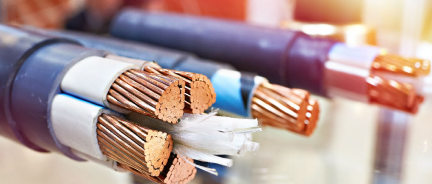
Garage wiring can involve several cable types depending on where the run is located and what it powers. Garage runs come in all shapes and forms: indoors, exposed conduit, underground, with each backed by a different cable. Here are the main cable types:
NM-B (Romex)
Non-metallic sheathed cable is the standard for branch circuits in attached garages or completely finished detached garages, in dry, protected locations. Common sizes for a garage are 12/2 for 20A receptacle and lighting circuits, and 10/3 or 6/3 for 240V equipment. NM-B is not rated for wet locations or direct burial, so it stays within the building envelope.
UF-B Underground Feeder Cable
UF-B is built for direct burial and damp locations. It is the go-to cable for running power out to a detached garage or to exterior receptacles when you are not using conduit. Per NEC 300.5, direct-buried UF-B residential branch circuits go a minimum of 24 inches deep, reduced to 12 inches for a GFCI-protected 120V, 20A circuit. For a 60A feeder over a short run, 6/3 UF-B with ground is a common choice.
THHN / THWN-2 Building Wire
For feeders pulled through conduit, individual THHN/THWN-2 conductors are the standard. It is the most common method for feeding a detached garage subpanel: run PVC conduit underground, then pull two hots, a neutral, and a ground. THWN-2 is rated for wet locations, and conduit runs underground are considered to be. Typical pulls are 4 AWG or 2 AWG for 100A service, plus the correctly sized grounding conductor.
SER and SEU Cable
Service entrance cable is used for subpanel feeders in dry, above-ground or indoor runs. SER (with ground) is a frequent choice for the feeder from a main panel to a subpanel when the cable is run indoors or in conduit rather than buried. It is not a direct burial cable, despite being mistaken for one.
MC Cable
Metal-clad cable is used in exposed runs where physical protection matters, such as along an unfinished garage wall or ceiling. The armour protects the conductors without the need to install a separate conduit. It is common in commercial-style and heavy workshop garages with exposed framing and a lot of tools.
Grounding and Bonding Conductor
A detached garage with a feeder-fed subpanel usually needs both an equipment grounding conductor in the feeder and a grounding electrode system at the garage. The grounding electrode conductor connects the subpanel’s ground bar to the ground rods or other approved electrodes; #6 AWG bare copper is common for ground rod connections. The feeder equipment grounding conductor is sized separately under NEC 250.122, based on the feeder breaker size: commonly #10 copper for a 60A feeder or #8 copper for a 100A feeder.
EV Charger Cable
A hardwired Level 2 charger is usually fed with 6 AWG copper THHN in conduit or 6/3 with ground, sized to a 60A circuit for a 48A charger. Running 6 AWG up front is the simplest way to future-proof for a higher-output charger; running a lower gauge is usually not worth it.
Cables for Garage Installation

Conduit and Wiring Methods
The wiring method depends on where the cable runs:
-
PVC conduit (Schedule 40 or 80) is best for underground feeders. Buried PVC must be at least 18 inches deep per NEC 300.5. Schedule 80 is used when the conduit exits the ground and is exposed to physical damage.
-
EMT (metal conduit) is the top choice for exposed indoor runs that need protection.
-
Cable alone (NM-B, UF-B, MC) where the wiring method permits, with NM-B confined to dry interior runs.
Grounding and Bonding
Grounding is the step most often done wrong on a detached garage. At the subpanel:
-
Keep the neutral bar and the ground bar separate. Remove the main bonding jumper so the neutral floats.
-
Install a grounding electrode at the garage, usually one or two 8-foot ground rods driven into the earth, and bond the subpanel ground bar to it.
-
Run the equipment grounding conductor all the way back with the feeder. The earth is not a substitute for that conductor.
In an attached garage sharing the main panel, the existing house grounding system serves the garage circuits, so no separate electrode is required.
Running Power to a Garage Step-by-Step
-
Calculate the load and decide whether to use branch circuits or a subpanel.
-
Pull the permit and confirm the local code cycle.
-
Size the subpanel, feeder conductors, and breakers, accounting for voltage drop on long runs.
-
Run the feeder conduit or cable to the required burial depths.
-
Mount and land the subpanel, keeping neutral and ground isolated.
-
Install the grounding electrode and bond it.
-
Run the branch circuits for receptacles, lighting, 240V equipment, and the EV charger.
-
Install GFCI protection on all garage receptacles.
-
Make up connections, label the panel, and schedule the inspection.
-
Energize only after the inspection passes.
GFCI, AFCI, and Safety
Every garage receptacle from 125V through 250V needs GFCI protection, with no exceptions for height or accessibility. You can provide it at the receptacle or at the breaker. Breakers are often the cleaner solution because a GFCI breaker protects the entire circuit and avoids reset buttons in awkward spots. Garages do not require AFCI, but GFCI is mandatory. Test every device before calling for the final inspection.
Nassau National Cable supplies the main cable types used in garage installations, including NM-B, UF-B, THHN/THWN-2 building wire, SER cable, MC cable, and bare copper grounding wire.
Сables Featured In This Blog

- Sale price
- $1.94
- Regular price
- $1.94

- Sale price
- $3.26
- Regular price
- $3.26

- Sale price
- $0.80
- Regular price
- $0.80

- Sale price
- $1.73
- Regular price
- $1.73

- Sale price
- $4.85
- Regular price
- $4.85

- Sale price
- $5.39
- Regular price
- $5.39


- Sale price
- $1.12
- Regular price
- $1.12

- Sale price
- $3.24
- Regular price
- $3.24