Garrie AI: Your Cable Guide

Data Center Cabling Standards Explained
Data centre cabling standards fall under a broader set of rules that govern the entire facility. ANSI/TIA-942-C is the primary standard, and its scope spans site selection and electrical systems through mechanical, fire protection, physical security, and telecommunications infrastructure. Cabling is one subsystem inside that document. On the cabling side, the rules specify which cable can go where, how it must perform, how it is grounded and labelled, and how it behaves in a fire. The remaining requirements come from ISO/IEC, IEEE, NFPA, UL, and ASHRAE, and no single document covers all of them. This guide goes through every standard that applies.
What ANSI and TIA Mean
Most data centre cabling standards carry an ANSI/TIA prefix, with two organisations playing distinct roles.
ANSI is the American National Standards Institute. It does not write standards. It accredits the organisations that do so, then approves their output as American National Standards. Accreditation requires an open consensus process, a public comment period, an appeals mechanism, and review every five years.
ANSI standards are voluntary on their own. They become mandatory only when adopted into law, incorporated by reference into a regulation, or written into a contract. That distinction matters for this guide. The NEC is law in most US jurisdictions, and the Construction Products Regulation is law across the EU, so both carry enforcement behind them. TIA-942, the TIA-568 series, BICSI 002, and the Uptime Tiers apply because a specification or a contract calls for them.
TIA is the Telecommunications Industry Association, a trade association and an ANSI-accredited standards developer. Its engineering committees write the cabling standards, and committee TR-42 handles premises telecommunications infrastructure. Members include manufacturers, installers, consultants, and operators, which is why TIA documents stay practical and installation-focused.
So, ANSI/TIA-942 means TIA wrote the document, and ANSI approved it. Other bodies appear throughout this guide under the same logic. NFPA publishes the National Electrical Code and fire protection standards. UL runs the safety and flame testing that earns the cable its rating. IEEE writes the Ethernet specifications. ISO/IEC and CENELEC publish the international and European equivalents.
BICSI is also ANSI-accredited, which is why its data center document carries the ANSI/BICSI 002 designation. Anyone can buy it and design against it.
Uptime Institute works differently. It is a private company, its Tier Standard is proprietary rather than ANSI-approved, and a Tier rating exists only when Uptime Institute audits a facility and issues one. No other party can assign a Tier.
How Data Center Standards Are Enforced
No single organisation enforces every standard in this guide. Requirements become binding in four ways.
Codes. The NEC and applicable building, fire, and mechanical codes become law when adopted by a state or local jurisdiction. The authority having jurisdiction, or AHJ, inspects the work and can withhold approval until violations are corrected. The enforced edition differs by location.
Contracts and specifications. TIA, ISO/IEC, IEEE, BICSI, and ASHRAE standards are voluntary in their own right. They become mandatory when a contract or an engineering specification requires them. Failure is then a contractual nonconformance, even when it is not a code violation.
Product certification. UL and other recognized testing laboratories certify cables and equipment against applicable safety and performance standards. The AHJ or the project team checks that the installed product is listed correctly and used within the conditions of that listing.
Facility certification. TIA-942 Rated levels and Uptime Institute Tiers are voluntary. Owners pursue them to satisfy stakeholders. Certification is separate from code approval. A facility can pass inspection without holding either one, and a certified facility still has to comply with local codes.
|
Requirement |
Who Checks It |
Consequence of Failure |
|
Adopted electrical, fire, and building codes |
AHJ, inspector, fire marshal |
Failed inspection or corrective work |
|
TIA, ISO/IEC, IEEE, BICSI, and ASHRAE requirements |
Engineer, owner, customer, auditor |
Rejected work or contractual claim |
|
Product listings and ratings |
Testing laboratory, procurement team, AHJ |
Product rejection |
|
TIA-942 or Uptime certification |
Authorised certification body |
Certification withheld or not renewed |
A single cable run can therefore be checked by the manufacturer, the contractor, the engineer, the inspector, and a certification auditor at different stages.
Core Data Center Infrastructure Standards
ANSI/TIA-942-C
ANSI/TIA-942-C is the anchor document. The Telecommunications Industry Association published the C revision in May 2024, replacing TIA-942-B. It follows the ANSI five-year review cycle.
The standard covers far more than cable. It specifies minimum requirements for site location, architecture, electrical systems, mechanical systems, fire protection, physical security, telecommunications infrastructure, and monitoring. It covers everything from a single rack to a multi-building campus.
TIA-942 also defines the Rated 1 through Rated 4 classification system, which describes redundancy across telecommunications, electrical, mechanical, and architectural subsystems. Rated 1 has no redundancy. Rated 4 has fault-tolerant redundancy in all four subsystems.
Several changes in the C revision affect cable selection directly:
-
Single balanced twisted-pair cable is now a recognized horizontal cabling medium, which supports IoT sensors and building control applications.
-
Wireless access points served by balanced twisted-pair require at least 2 Category 6A runs.
-
Horizontal and backbone cabling should include a minimum of two optical fibers.
ISO/IEC 11801-5
ISO/IEC 11801-5 is the international equivalent of the TIA cabling standards for data centre spaces. It defines channel classes rather than categories, so Class EA roughly corresponds to Category 6A, and Classes I and II correspond to Category 8 performance tiers.
Projects outside North America usually reference 11801-5, where the same requirements are typically referred to as data centre cabling standards. Multinational operators frequently design to both documents at once, since the requirements overlap heavily and conflicts are rare.
ANSI/BICSI 002
ANSI/BICSI 002 is a design and implementation best practices document. It goes deeper than TIA-942 in layout, power distribution, cooling, and commissioning, and it includes its own availability classification, running from Class F0 through Class F4.
Engineers typically use TIA-942 to define what the infrastructure must include and BICSI 002 to determine how to build it.
Uptime Institute Tier Standard
The Uptime Institute Tier Standard is a commercial certification framework rather than an ANSI standard, and it classifies facilities from Tier I through Tier IV. Uptime certifies designs and constructed facilities separately, so a design certification says nothing about what was actually built.
How Modern Data Center Types Relate to Resilience Levels
A data center's type and its resilience level describe different things.
The type explains ownership, scale, location, construction method, or workload.
The resilience level explains how the facility handles maintenance and failure. TIA uses Rated 1 through 4, BICSI uses Classes F0 through F4, and Uptime Institute uses Tiers I through IV.
The common types describe the following:
-
Enterprise: internal ownership and use
-
Colocation: multi-tenant commercial model
-
Hyperscale or cloud: scale and service-delivery model
-
Edge or micro edge: proximity to users, devices, or operations
-
Modular or prefabricated: construction method
-
AI or HPC: workload and power-density profile
Any of them can be built to any resilience level.
A hyperscale facility is not automatically Tier IV, and a small edge site is not automatically Tier I. The owner sets the resilience target by weighing the cost of an outage against the cost of building and running the redundancy.
Cloud and hyperscale operators also rely on software replication across several facilities. That can make the overall service resilient even when an individual building is not certified at the highest level. Facility ratings measure the physical resilience of one site, not the availability of the entire application or platform.
The practical rule: data center type does not determine resilience level.
Resilience Classification Systems Compared
Three parallel systems classify data center redundancy, and specifications frequently reference all three. The levels are not interchangeable.
Uptime Institute Tiers
|
Tier |
Requirement |
Effect |
|
Tier I |
Basic capacity. Single power and cooling path, no redundant components. |
Any maintenance or failure takes IT offline. |
|
Tier II |
Redundant capacity components. Single distribution path, N+1 components. |
Component failure is survivable. Path work still causes downtime. |
|
Tier III |
Concurrently maintainable. Multiple distribution paths, one active. |
Any component or path can be serviced without a shutdown. |
|
Tier IV |
Fault-tolerant. Multiple active paths, 2N or 2N+1 components. |
Any single failure causes no IT impact, including during maintenance. |
Uptime Institute assigns a single rating to the entire facility, and the weakest subsystem determines the result.
BICSI 002 Availability Classes
|
Class |
Requirement |
|
F0 |
Single path, no redundancy. No availability requirement. |
|
F1 |
Single path with limited component redundancy. |
|
F2 |
N+1 redundancy in critical components. Single distribution path. |
|
F3 |
Concurrently maintainable and operable. Multiple paths. |
|
F4 |
Fault-tolerant. Continuous operation through any single failure. |
BICSI classes apply per subsystem rather than to the facility as a whole. A site can be Class F3 on electrical and Class F2 on mechanical, which gives designers a more granular way to allocate budget.
How the Systems Line Up
|
TIA-942 Rated |
BICSI 002 Class |
Uptime Tier |
Redundancy Level |
|
n/a |
F0 |
n/a |
None |
|
Rated 1 |
F1 |
Tier I |
Single path, basic |
|
Rated 2 |
F2 |
Tier II |
Redundant components |
|
Rated 3 |
F3 |
Tier III |
Concurrently maintainable |
|
Rated 4 |
F4 |
Tier IV |
Fault tolerant |
The mapping is approximate, and the three systems are assessed differently.
Data Center Structured Cabling Standards
ANSI/TIA-568.2-E
ANSI/TIA-568.2-E governs balanced twisted-pair cabling performance. It specifies the electrical characteristics of Category 5e, Category 6, Category 6A, and Category 8.
Category 6A is the working default for horizontal runs in modern data centers. It supports 10GBASE-T to 100 meters and handles Power over Ethernet heat loads better than Category 6.
Category 8 was written specifically for data center use. It runs to 2 GHz and supports 25GBASE-T and 40GBASE-T over a 30-meter channel with a maximum of two connectors. That distance restricts it to top-of-rack and end-of-row switch-to-server links.
ANSI/TIA-568.3-E
ANSI/TIA-568.3-E covers optical fiber components. It recognizes OM3, OM4, and OM5 multimode fiber along with OS2 singlemode fiber, and it defines connector and adapter requirements.
Fiber selection follows the target speed and distance. OM5 carries several wavelengths on one fiber pair, which gets more capacity out of fewer strands. OS2 single-mode runs much farther than any multimode grade, so it handles campus backbone and long links.
Supported distances by fiber grade and application:
|
Application |
OM3 |
OM4 |
OM5 |
OS2 |
|
10GBASE-SR |
300 m |
400 m |
400 m |
n/a |
|
40GBASE-SR4 |
100 m |
150 m |
150 m |
n/a |
|
100GBASE-SR4 |
70 m |
100 m |
100 m |
n/a |
|
400GBASE-SR8 |
70 m |
100 m |
100 m |
n/a |
|
10GBASE-LR |
n/a |
n/a |
n/a |
10 km |
|
100GBASE-LR4 |
n/a |
n/a |
n/a |
10 km |
TIA-598
TIA-598 defines fiber optic color coding for cable jackets, buffer tubes, and connectors. Aqua is commonly used for OM3; OM4 may be aqua or violet; lime green identifies OM5; and yellow identifies singlemode. Project specifications should follow the current edition and the manufacturer's markings. Consistent color coding reduces cross-connect errors during moves, adds, and changes.
Pathways, Grounding, and Administration
ANSI/TIA-569-E
ANSI/TIA-569-E covers telecommunications pathways and spaces. It sets cable tray sizing, conduit fill ratios, bend radius allowances, and separation requirements between power and telecommunications pathways.
Fill ratios matter more in data centers than in commercial buildings because bundle density affects heat dissipation. Overfilled trays raise cable temperatures, increasing insertion loss on copper links.
Key rules from TIA-569-E and NEC Chapter 9:
-
Conduit fill is limited to 40 percent for three or more cables, 31 percent for two cables, and 53 percent for a single cable.
-
Cable tray fill should not exceed 50 percent of usable cross-sectional area, with 25 percent recommended at initial install to allow for growth.
-
Conduit runs are limited to two 90 degree bends between pull points, and 30 meters between pull boxes.
-
Separation from unshielded power lines under 2 kVA is 5 inches when both run in an open pathway, and 0 inches when power is in a grounded metal conduit.
-
Telecommunications rooms require a minimum 3-foot clearance in front of equipment racks and 2 feet at the rear.
ANSI/TIA-606-D
ANSI/TIA-606-D defines the labeling and administration system for cabling infrastructure. It specifies identifier formats for each cable, pathway, and termination, and requires records linking each identifier to its physical location.
TIA-942 compliance depends on 606-D documentation. Certification audits check records as closely as they check hardware.
Key rules from TIA-606-D:
-
Four administration classes apply. Class 1 covers a single telecommunications space; Class 2 covers multiple spaces in a single building; Class 3 covers a campus; and Class 4 covers multiple sites.
-
Every cable, termination position, pathway, space, and grounding busbar requires a unique identifier.
-
Labels must be legible, permanent, and resistant to the environmental conditions of the installed location.
-
Both ends of every cable require matching identifiers.
-
Records must link each identifier to its location, type, and connected equipment.
-
Color coding identifies the termination function. Blue marks horizontal to the work area, gray marks second-level backbone, and orange marks the demarcation point.
ANSI/TIA-607-E
ANSI/TIA-607-E covers bonding and grounding for telecommunications systems. Every cabinet in a data center needs a bonded path back to the building grounding electrode system. Shielded twisted-pair depends on that path, and an unbonded shield can perform worse than no shield at all.
Key rules from TIA-607-E:
-
The telecommunications bonding backbone requires a minimum 6 AWG conductor. Common practice is to run 3/0 AWG in data centres.
-
Rack and cabinet bonding conductors require a minimum 6 AWG.
-
Bonding conductors should be continuous with no splices, and routed as directly as practical.
-
Green insulation identifies telecommunications bonding conductors.
-
The resistance between any two points in the bonding network should be less than 1 ohm.
Network Transmission Standards
The IEEE 802.3 family defines the Ethernet physical layer specifications that cabling must support.
Key specifications include 802.3an for 10GBASE-T, 802.3bq for 25GBASE-T and 40GBASE-T, 802.3ba and 802.3bs for 40G through 400G optical links, and 802.3df for 800G. IEEE 802.3bt defines Power over Ethernet up to 90 watts, which affects bundle sizing and temperature rise in dense pathways.
Pick the Ethernet speed first, then the cable grade that carries it the distance you need.
Fire Safety Standards for Data Center Cabling Materials
Fire safety standards for data center cabling materials fall into two groups. Installation codes specify which cable rating is permitted in which spaces, and flame-test standards determine how a cable earns that rating. Check article numbers against the NEC edition your jurisdiction has adopted, since they change between editions.
NEC Article 645
NEC Article 645 covers information technology equipment rooms. It addresses wiring under raised floors, disconnecting means, and permitted cable types within the IT room envelope. An IT room that meets all Article 645 conditions, including a dedicated HVAC system and a disconnecting means, can run non-plenum cable under the raised floor, even though that space carries air. Miss any one condition and the normal plenum rules apply.
NEC Article 770
NEC Article 770 governs optical fiber cables and raceways. It establishes the OFNP, OFNR, OFNG, and OFN listing hierarchy along with placement rules for each. The OFC variants cover cables with conductive members.
NEC Articles 800 and 805
NEC Article 800 sets general requirements for communications systems, and Article 805 covers communications circuits. The applicable communications provisions establish the CMP, CMR, CM, and CMX hierarchy. Plenum-rated cable can replace riser-rated cable, but riser-rated cable cannot replace plenum-rated cable.
|
Rating |
Permitted Use |
Acceptable Substitutes |
|
CMP / OFNP |
Plenum, riser, general |
None required |
|
CMR / OFNR |
Riser, general |
CMP, OFNP |
|
CM / CMG / OFNG |
General purpose |
CMP, CMR |
|
CMX |
Dwellings, raceway, limited use |
CMP, CMR, CM |
The NEC also limits how far unlisted outside cable may extend from the point of entrance into a building. Confirm the exact allowance in your NEC version.
NFPA 75
NFPA 75 is the fire protection standard for information technology equipment facilities. It addresses construction, fire-suppression systems, and cable requirements in IT spaces and works alongside NEC Article 645.
NFPA 262 and UL 1666
NFPA 262, historically known as UL 910, is the plenum flame and smoke test. Cables that pass earn CMP or OFNP ratings and can be installed in environmental air spaces. The test measures both flame spread and smoke density, which is why plenum cables use fluoropolymer jackets.
The test runs in a 25-foot Steiner tunnel. Samples are placed in a single layer on a cable tray and exposed to a methane burner under forced draft for 20 minutes. Pass criteria are strict and specific:
|
Measurement |
Limit |
|
Flame travel distance |
5 feet (1.52 m) maximum |
|
Peak optical density of smoke |
0.50 maximum |
|
Average optical density of smoke |
0.15 maximum |
UL 1666 is the riser flame test. It evaluates vertical flame propagation between floors, and cables that pass earn CMR or OFNR ratings for use in vertical shafts. The test uses a simulated two-story shaft with a 17-foot cable bundle, which is burned for 30 minutes. Flame height must stay under 12 feet, measured from the burner. UL 1666 measures flame height and temperature only, and it does not evaluate smoke density or toxicity.
That difference explains the rating hierarchy. Plenum cable passes a smoke test that riser cable never faces, which is why CMP substitutes for CMR and CMR never substitutes for CMP.
Construction Products Regulation
EU Regulation 305/2011, known as the Construction Products Regulation, applies to cables permanently installed in European buildings. It assigns Euroclass fire ratings from Aca through Fca, with additional classifications for smoke, acidity, and flaming droplets. Data centers in the EU commonly specify Cca-s1b,d1,a1 or better.
A CMP rating does not satisfy CPR. Cable bought for both regions needs both.
Thermal Guidelines
ASHRAE TC 9.9 defines the thermal envelope classes for data center equipment environments, running from Class A1 through Class A4. Each class sets recommended and allowable ranges for temperature and humidity.
|
Class |
Allowable Temperature |
Typical Application |
|
Recommended (all classes) |
18 to 27 degrees C (64.4 to 80.6 F) |
Design target |
|
A1 |
15 to 32 degrees C |
Enterprise servers, storage |
|
A2 |
10 to 35 degrees C |
Volume servers, storage |
|
A3 |
5 to 40 degrees C |
Volume servers, personal computers |
|
A4 |
5 to 45 degrees C |
Volume servers, personal computers |
The recommended humidity range runs from a 5.5 degree C dew point to a 15 degree C dew point and 60 percent relative humidity.
TIA-942-C now requires the recommended envelope from ASHRAE TC 9.9. This matters for cable because copper insertion loss rises with temperature.

How the Standards Work Together
Here is how the standards work together, using a single horizontal run as an example:
-
TIA-942-C places the run in the horizontal distribution area.
-
TIA-568.2-E sets the Category 6A performance that it has to meet.
-
IEEE 802.3an defines the 10GBASE-T application it carries.
-
TIA-569-E sets the tray fill and bend radius during installation.
-
NEC communications provisions require a CMP rating where the pathway crosses a plenum.
-
NFPA 262 is the test that cables pass to earn the rating.
-
TIA-607-E grounds the cabinet at each end.
-
TIA-606-D assigns the label.
-
ASHRAE TC 9.9 sets the ambient temperature against which the channel was tested.
Frequently Asked Questions
What is the main data center cabling standard?
ANSI/TIA-942-C is the primary standard for data center telecommunications infrastructure in North America. ISO/IEC 11801-5 serves the same role internationally.
What is the current version of TIA-942?
TIA-942-C, published in May 2024. It replaced TIA-942-B and incorporated the TIA-942-B-1 addendum on edge data centers.
What cable category do data centers use?
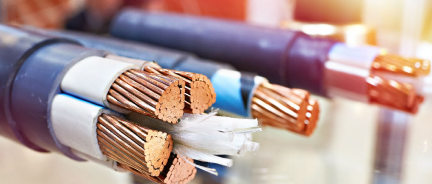
Category 6A is standard for horizontal runs. Category 8 handles short switch-to-server links up to 30 meters. Fiber handles backbone and higher-speed connections. Data centers also consume large volumes of power cable, including THHN and XHHW-2 feeders, MC cable for branch circuits, tray cable, and medium voltage cable for utility service and substation connections.
Do data centers require plenum-rated cable?
Plenum rating is required when cable runs through an environmental air space. Many data centers use raised floors or ceilings as air plenums, which makes CMP and OFNP cable in those pathways. NEC Article 645 provides limited alternatives for rooms that meet all its conditions.
What is the difference between TIA-942 Rated levels and Uptime Tiers?
TIA-942 Rated 1 through 4 scores redundancy across four subsystems: telecommunications, electrical, mechanical, and architectural. Uptime Tier I through IV scores infrastructure topology and is awarded only by Uptime Institute. The two systems are independent.
Who enforces data center cabling standards?
Local authorities enforce adopted electrical, fire, and building codes. Engineers, owners, and customers enforce the standards set forth in contracts and specifications. Testing laboratories certify products, and TIA and Uptime certification bodies evaluate facilities under their own programs.
Does every data center need a Tier rating?
No. Tier and Rated classifications are voluntary unless a customer, contract, insurer, or internal policy requires them. A facility still has to comply with locally adopted codes when it does not pursue certification.
Does the data center type determine its Tier?
No. Enterprise, colocation, hyperscale, edge, modular, and AI describe the facility's use or design model. Any of them can be built to different resilience levels depending on the consequences of downtime.
What does ANSI/TIA mean?
TIA is the Telecommunications Industry Association, which writes the standard. ANSI is the American National Standards Institute, which accredits TIA and approves the finished document as an American National Standard. The combined prefix indicates both steps were completed.
What are BICSI Class F0 through F4?
BICSI 002 availability classes rate data center redundancy from F0, meaning no redundancy, through F4, meaning fault-tolerant. Unlike Uptime Tiers, BICSI classes can be applied to individual subsystems rather than the whole facility.
Sourcing Standards-Compliant Data Center Cable
Nassau National Cable supplies both sides of a data center build. On the network side, we stock Category 6A, Category 8, and fiber optic cable in CMP, CMR, OFNP, and OFNR ratings. On the power side, we carry medium voltage cable for utility service and substation feeds, utility wire and cable for distribution, and THHN and XHHW-2 building wire, feeder-size Type MC cable, and tray cable for feeders and branch circuits.
Every product listing includes the applicable listings and ratings, so specifiers can match cable to the standards their project requires. See our data center wire and cable page for how we supply data center builds, or contact our team to start your project with us.
Сables Featured In This Blog


- Sale price
- $6.18
- Regular price
- $6.18


- Sale price
- $8.98
- Regular price
- $8.98

- Sale price
- $8.29
- Regular price
- $8.29

- Sale price
- $1.76
- Regular price
- $1.76

- Sale price
- $3.52
- Regular price
- $3.52

- Sale price
- $16.23
- Regular price
- $16.23

- Sale price
- $37.23
- Regular price
- $37.23