Garrie AI: Your Cable Guide

Wiring AI Data Centers: What’s Different From Traditional Data Centers

Artificial intelligence is changing how data centers are built. Traditional facilities were designed for steady, moderate CPU workloads. AI data centers, by contrast, are engineered to support dense GPU clusters that demand significantly more power and generate more heat.
In this article, we explore how AI data centres are different from traditional ones in terms of what they demand.
How AI Workloads Change Power and Cabling Requirements
Traditional data centers typically operate at 5–10 kW per rack. AI racks, especially those used for training large models, can reach 30–100+ kW per rack. That increase in density fundamentally changes electrical planning.
Higher power demand means:
-
Larger feeder conductors
-
More frequent use of parallel cable runs
-
Increased reliance on higher-temperature insulation ratings
-
More robust grounding and bonding strategies
-
Tighter coordination between power and cooling systems
AI workloads also tend to run at sustained high utilization, so there is more continuous stress on conductors and insulation systems. Unlike traditional environments with fluctuating demand, GPU clusters can operate near peak load for extended periods. That sustained electrical stress places greater demands on the system as a whole.
For example, in a traditional data center, a feeder might use a single 500 kcmil copper THHN/THWN-2 conductor per phase, sized close to the calculated load under moderate utilization assumptions.
In a high-density AI data center where GPU racks operate near peak load for extended periods, engineers will likely switch from THHN to XHHW-2 for better thermal regulation and use parallel conductors, for example, 2 × 350 kcmil per phase instead of one 500 kcmil. Parallel runs in this context reduce heat.
Power Distribution Path in an AI Data Center

Here is how power is typically distributed in AI data center:
1. Utility Grid
The process begins with power supplied by the local utility provider. Large AI data centers typically receive medium-voltage (MV) service directly from the grid due to their significant load requirements.
Because AI facilities demand continuous high power, utility coordination and service capacity planning are critical at this stage.
2. Medium-Voltage Service Entrance
Power enters the facility through medium-voltage cable in underground or duct-bank installations. These cables must be rated for high load and long service life.
Medium-voltage distribution is used because it allows large amounts of power to be transmitted efficiently with reduced current and lower losses.
3. Main Switchgear
The main switchgear controls, protects, and isolates incoming power. It includes circuit breakers and protection devices that prevent faults from propagating through the system.
In AI data centers, switchgear is often designed with redundancy to support continuous operation even during failure events.
4. Transformer (MV to LV Conversion)
Transformers step down medium voltage to usable low voltage (commonly 480V or 415V in modern data centers).
5. UPS System (Uninterruptible Power Supply)
Before reaching IT equipment, power passes through a UPS system. This stage provides short-term backup power during outages and stabilizes voltage irregularities. AI workloads are highly sensitive to interruptions.
6. Secondary Distribution (Busway or Feeder Cables)
After UPS, power is distributed throughout the data hall using:
-
Busway systems
-
Feeder cables (often THHN, THWN-2, or XHHW-2)
-
Structured tray systems
7. Rack PDUs (Power Distribution Units)
Rack-level PDUs distribute power from the main feeders to individual servers within each rack. AI racks often operate at significantly higher density than traditional racks with higher load concentrations.
Redundant A/B feeds are commonly used to ensure uptime.
8. AI Servers / GPU Clusters
Finally, power reaches the AI servers and GPU clusters. These systems run at sustained high utilization.
At this point, all upstream cable sizing, insulation selection, grounding, and redundancy planning directly impact reliability and performance.
Power and Communication Cable Types in AI Data Centers
AI facilities use a mix of power and communication cabling depending on voltage level and distribution architecture.
Common power cables include:
-
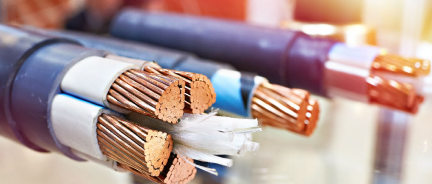
Medium-voltage cable for utility feeds (MV-90 / MV-105)
-
THHN / THWN-2 for branch circuits
-
XHHW-2 for higher temperature tolerance and feeder runs
-
Tray cable (TC-ER) in structured tray systems
-
Type W cable and DLO (Diesel Locomotive Cable) for generator connections
-
Grounding conductors for fault protection and bonding
Communication cabling typically includes:
-
Fiber optic cable
-
High-category Ethernet cable
Fiber becomes especially important in AI data centers due to bandwidth requirements and electromagnetic interference resistance.
Challenges in High-Load AI Environments
AI data centers operate under more demanding conditions than traditional facilities.
Key challenges include:
-
Sustained near-peak electrical loads
-
Increased thermal stress on insulation and thermal accumulation
-
Rapid infrastructure expansion
-
Stricter uptime requirements
-
Higher financial risk from downtime
What We See in Real AI Data Center Projects
Working with customers at Nassau National Cable, we consistently observe several patterns in large AI infrastructure data centers:
-
Power density is often underestimated during early planning stages
-
Tray capacity becomes constrained faster than expected
-
Lead times can impact deployment schedules negatively, which is critical as data centers require massive amounts of cable
AI data centers move fast, and infrastructure decisions made early in the project can have long-term consequences.
How Nassau National Cable Supports Large AI Data Center Projects
At Nassau National Cable, we support AI data center builds by providing:
-
Access to a wide range of power cables for AI data centers
-
Consistent product availability for large-scale projects
-
Help in selecting cables appropriate for the project
-
Offering alternatives if certain cables cannot be sourced in the US at the given moment.
-
Support for bulk orders and project-based supply
-
Reliable delivery aligned with construction timelines
-
Code and standards compliance support
-
Supply continuity planning
-
Backup sourcing options
-
Phased delivery coordination
-
Inventory transparency
-
Multi-site fulfillment support