Garrie AI: Your Cable Guide

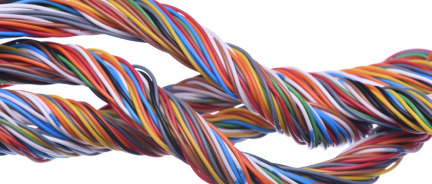
Panel Wire Color Code Chart
Residential and commercial load centres use a single-colour system: NEC power wiring. Industrial panels, such as MCCs, machine control enclosures, and automation panels carry two: NEC power conductors and NFPA 79 control wiring, often in adjacent wireways. This chart covers both.
Note on DC wiring: DC systems — solar, EV, telecom — use a separate color convention. See our dedicated DC wire color codes post for full coverage.

NEC wire colors: power wiring
The NEC reserves white and grey neutrals, and green (or bare) for grounds. Hot conductor colours are not mandated by code. They follow the NECA convention, which is universally observed in practice.
Hot conductors
Black — Phase A in 120 V and 240 V systems. Carries line voltage from the breaker to the load; the most common hot conductor in residential wiring, lighting circuits, and general-purpose receptacle branch circuits.
Red — Phase B in 240 V two-pole circuits and three-way switch legs. Used as the second hot in appliance circuits (ranges, dryers, HVAC), and as the traveller or switched leg in multi-way lighting control.
Orange — Phase C in high-leg delta systems, where it measures 208 V to neutral instead of the expected 120 V. Required to be orange by NEC 230.56 and 408.3(E); found in older commercial and light industrial facilities still running three-phase delta service.
Blue — Phase A in 277/480 V four-wire wye systems. Supplies 277 V to ground, used primarily for commercial fluorescent and LED lighting circuits and as one leg of 480 V motor loads.
Yellow — Phase C in 277/480 V systems. Third hot leg in four-wire wye distribution; feeds lighting, HVAC equipment, and motor branch circuits in commercial and industrial facilities.
Violet / Purple — Phase B in 277/480 V four-wire wye systems. Second hot leg; used for the same load types as blue and yellow in three-phase distribution panels and switchboards.
Neutral
White — Grounded conductor in 120/240 V systems. Carries return current from the load back to the neutral bus; bonded to ground at the service entrance. Standard in all residential panels and most commercial branch circuits.
Gray — Grounded conductor in 277/480 V systems. Same function as white, but used at higher voltages to distinguish the neutral from 120/240 V circuits in the same enclosure. Also acceptable as an alternative neutral color at lower voltages.
Ground
Green — Insulated equipment grounding conductor (EGC). Bonds equipment enclosures and metallic parts to the ground bus; carries no current under normal operation, only during a fault. Used where the grounding conductor needs insulation for mechanical protection or routing through conduit with other conductors.
Green / Yellow stripe — Insulated EGC for isolated ground circuits or sensitive equipment. The stripe identifies it as a separate isolated ground path, used with isolated ground receptacles in labs, data centres, and facilities with sensitive electronics to reduce electrical noise.
Bare copper — EGC in feeder and branch circuit wiring. The most common grounding conductor in conduit systems and cable assemblies; no insulation is required by the NEC. Found in virtually every panel connecting the ground bus to outlet boxes, equipment enclosures, and subpanels.
White, grey, and green are always reserved. A white wire repurposed as a hot must be re-identified with tape or marking at both ends.
Control and low-voltage wire colors (NFPA 79)
Control wiring follows NFPA 79 — not the NEC. Colors overlap with power wiring in some cases, which is why physical separation of power and control wireways matters.
AC control
-
Red — 24 V AC/DC positive. Control power, relay coil supply.
-
White — AC neutral or DC negative. Control circuit common.
-
Black — 120 V AC control legs inside the panel.
DC control
-
Blue — DC positive, ungrounded circuits (NFPA 79 Ch. 13).
-
Grey — DC negative or return.
Safety and signal
-
Yellow — Safety interlock circuits, e-stop loops, safety relays. Reserved for circuits that initiate a safe state when de-energised.
-
Violet / Purple — Pilot signals, sensor inputs, 4-20 mA analogue loops.
-
Orange — Switched outputs from PLCs, SSRs, or interposing relays.
-
Green — Panel ground bus, cable shield drains.
Yellow means safety. Do not repurpose it for general control wiring.

Need wire and cable for your electrical panel?
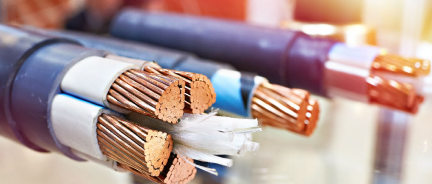
Nassau National Cable stocks THHN, XHHW, tray cable, and instrumentation cable in all standard gauges and colors. Call us or get a quote online.