Garrie AI: Your Cable Guide

High Voltage Color Code: How to Identify MV and HV Cables
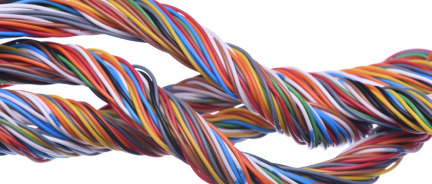
Search for a high voltage color code, and you will find charts assigning black, red, blue, brown, orange, yellow, and other colors to electrical conductors. These charts can be useful, but they can also give the impression that every high-voltage cable follows the same system.
It does not. There is no single universal high voltage color code. Conductor identification depends on the voltage level, country, applicable standard, utility requirements, and project specifications. This becomes particularly important when distinguishing low-voltage building wiring from medium-voltage (MV) and high-voltage (HV) power cables.

Common U.S. Wire Color Codes
In the United States, several color combinations are widely used for building wiring.
For 120/208/240 V three-phase systems, a common convention is:
-
Black: Phase A / L1
-
Red: Phase B / L2
-
Blue: Phase C / L3
-
White: Neutral
-
Green, green/yellow, or bare: Equipment grounding conductor
For 277/480 V systems, installers commonly use:
-
Brown: Phase A / L1
-
Orange: Phase B / L2
-
Yellow: Phase C / L3
-
Gray: Neutral
-
Green, green/yellow, or bare: Equipment grounding conductor
These are common U.S. industry conventions rather than a universal NEC-mandated phase-color sequence. Also, despite sometimes appearing in searches for a high voltage color code, 277/480 V is normally considered low-voltage power distribution in the cable and utility industries.
IEC Wire Colors
IEC-based installations commonly use a different system:
-
Brown: L1
-
Black: L2
-
Gray: L3
-
Blue: Neutral
-
Green/yellow: Protective earth
This is one reason a conductor should never be identified from color without first knowing which standard applies.
Is There a Difference Between MV and HV Cable Identification?
Yes, although there is no single worldwide boundary separating medium voltage from high voltage.
In the power-cable industry, medium-voltage cable commonly includes distribution classes such as 5 kV, 15 kV, 25 kV, and 35 kV. Nassau National Cable carries a range of medium-voltage power cables across these voltage classes. These cables are widely used for utility distribution, industrial facilities, campuses, renewable-energy projects, and data centers.
High-voltage cable generally refers to higher system voltages used for subtransmission and transmission, such as 69 kV, 115 kV, 138 kV, and above. NNC, for example, offers transmission-class cable including 69 kV high-voltage cable and 115 kV high-voltage power cable. Exact classifications vary by standard and utility.
The identification methods are similar, but the cable construction and installation practices differ.
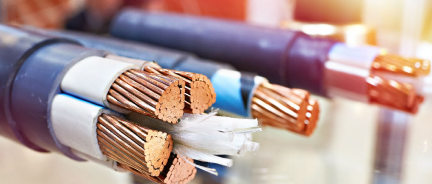
MV systems commonly use shielded single-core cables, frequently with black jackets. Three phases may therefore look nearly identical along most of their length. Colored tape, sleeves, tags, or labels at terminations can identify A/B/C or L1/L2/L3. Multi-core MV cables may instead use differently colored or numbered cores.
HV cables are even less likely to rely on full-length insulation colors as their primary means of identification. They are commonly installed as large single-core cables, with phase identification handled through tags, termination markings, circuit numbers, installation drawings, and project documentation. The cable's voltage class is determined from its printed legend, construction, specifications, and system documentation instead of conductor colors.
How Are MV and HV Cables Identified?
For MV and HV systems, identification typically combines:
-
Printed cable legend and voltage rating
-
A/B/C or L1/L2/L3 phase labels
-
Colored tape, sleeves, tags, or numbered cores
-
Manufacturer cable specifications
-
Utility or project drawings
-
Cable construction and insulation system
-
Testing and phase verification before energization
The key distinction is simple: color may identify the phase, but it does not identify the voltage class. The correct high voltage color code is therefore the identification system specified for the particular installation rather than one universal chart.
For data centers, utility distribution, industrial plants, and major infrastructure projects, Nassau National Cable supplies medium-voltage power cables and high-voltage power cables for demanding power-distribution applications. Its MV range includes 5 kV, 15 kV, 25 kV, and 35 kV products, while its HV offerings include cable for 69 kV, 115 kV, and 138 kV systems. NNC can help source cable by voltage class, conductor material, insulation, shielding, jacket construction, and project requirements rather than relying on color alone.