Garrie AI: Your Cable Guide


A Complete List of Electrical Tools and Equipment Explained
Every electrician, whether an enthusiast or a pro, works with a core set of electrical tools and equipment that covers hand tools, diagnostics, installation, and safety. This guide breaks down the complete list: what each tool is, what it does, and when you'll actually reach for it.

Basic Electrical Hand Tools
These are the tools electricians use on every job every day. No kit is complete without them.
Lineman's pliers
The workhorse of any electrician's kit. Used to grip, twist, and cut conductors during splicing, loop forming, and cable pulls.
Use when: Pulling wire through a tight conduit, twisting conductors together for a splice, or cutting heavy-gauge wire that diagonal cutters won't handle.
Needle-nose pliers
Built for tight boxes and crowded terminals. Used for bending conductors and positioning wires with precision in confined spaces.
Use when: Working inside a crowded junction box, bending small-gauge wire into terminal loops, or retrieving a wire that's slipped behind a device.
Diagonal cutters
Cut wires flush at the tip where standard pliers won't fit. Used when a clean, close cut is required.
Use when: Trimming wire ends inside a panel, clipping zip ties flush, or cutting in spaces too tight for lineman's pliers. Keep a separate pair for copper only, as cutting cable armour dulls the blades fast.
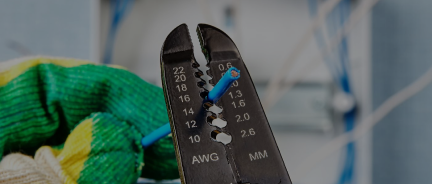
Wire strippers
Used to remove insulation without nicking the conductor. Sized by gauge, so you'll carry a range to match different wire types on site.
Use when: Prepping any conductor for termination. Always match the stripper gauge to the wire. A nick in the conductor is a future failure point.
Crimping tool
Secures terminals and lugs onto conductors, creating a reliable mechanical and electrical connection.
Use when: Terminating wire to ring terminals, butt connectors, or lugs, or any connection where a solder joint isn't appropriate or practical. Don't substitute with pliers; an improper crimp will fail under vibration or load.
Insulated screwdrivers
Voltage-rated for electrical work. Used to install devices and tighten terminals without shock risk.
Use when: Working on or near energized equipment. Check the rating: a true insulated screwdriver is rated to 1,000V and marked accordingly. Standard screwdrivers with rubber handles are not the same thing.
Nut drivers
Drive hex-head screws common in panels and electrical equipment. Faster and more controlled than pliers.
Use when: Installing or removing hex-head screws on panel knockouts, conduit locknuts, or equipment covers. Much faster than an adjustable wrench for repetitive fastening.
Adjustable wrench
Handles fittings, connectors, and hardware of varying sizes. One tool that adapts across jobs.
Use when: Tightening conduit fittings, compression connectors, or locknuts when you don't have the exact wrench size. Keep it snug against the fitting to avoid rounding the hardware.
Allen keys (hex set)
Required for equipment with hex fasteners, including fixtures and certain terminal assemblies.
Use when: Installing recessed fixtures, tightening set screws on motor terminals, or any equipment with hex socket fasteners. A T-handle hex set gives significantly more torque than a standard L-key in tight spaces.
Electrical Testing and Diagnostic Tools
These are the tools electricians use to verify circuits, troubleshoot and confirm system conditions before and after installation.
Multimeter
Measures voltage, current, and resistance. The single most essential diagnostic tool for any electrical work.
Use when: Verifying a circuit is de-energized before work, checking voltage at a receptacle, measuring resistance across a load, or confirming continuity in a run. Never rely on visual inspection alone and always verify with the meter.
Clamp meter
Measures current without disconnecting conductors. Fastest way to run diagnostics on a live system.
Use when: checking load current on a live circuit without breaking the connection, or verifying that a circuit is within its rated ampacity. Position the clamp around a single conductor only, as clamping multiple conductors at once cancels the reading.
Non-contact voltage tester
Detects live voltage without touching the conductor. First, perform a safety check before working on any circuit.
Use when: Confirming a circuit is de-energised before cutting or terminating, checking an outlet for live voltage, or identifying which conductors in a bundle are hot. Never use this as your only verification; always follow up with a multimeter for confirmation.
Continuity tester
Confirms whether a circuit path is complete. Used when verifying connections and wiring integrity before energizing.
Use when: Testing a switch, fuse, or conductor for a complete path. Always use on de-energised circuits only: a continuity tester is not rated for live voltage.
Outlet tester
Checks receptacle wiring for correct polarity and grounding. Provides instant feedback on the most common wiring errors.
Use when: Verifying receptacle installations during rough-in, troubleshooting a reported "bad outlet," or doing a fast quality check after a panel change. The LED pattern tells you the fault type without opening the device.
Insulation tester (megger)
Tests the insulation resistance under high voltage. Detects conductor degradation before it becomes a failure or fire hazard.
Use when: Commissioning new wire runs, troubleshooting unexplained tripping, or testing cables that have been exposed to moisture or physical damage. Disconnect all sensitive equipment before testing, as megger voltages will damage electronics.
Thermal camera
Identifies heat buildup in electrical components. Catches loose connections and overloaded circuits that aren't yet tripping breakers.
Use when: Performing preventive maintenance on panels, investigating unexplained heat complaints, or doing post-installation quality checks on large systems. A connection that reads hot under load but looks fine visually is a fire risk.
Circuit breaker finder
Identifies which breaker controls a specific circuit and eliminates guesswork during panel work.
Use when: Working in a building with an unlabeled or poorly labelled panel, or confirming which breaker feeds a specific outlet before beginning work. Much faster than tripping breakers one at a time.
Cable tracer (tone and probe)
Sends a signal through a conductor and tracks its path. Used to identify and trace unknown wires in walls or bundles.
Use when: Identifying an unmarked conductor in a conduit bundle, tracing a wire through walls without opening them, or locating the end of a run in a complex system. Works on de-energized circuits only.
Electrical Installation Tools
Fish tape
Pulls wire through conduit and wall cavities. Standard for new installations and extensions.
Use when: Pulling wire through conduit runs, fishing cable through finished walls, or navigating around obstacles in a cavity. Fibreglass fish tape is non-conductive and preferred in energised areas; steel tape pulls heavier loads.
Cable puller
Assists with long or heavy wire runs. Reduces strain and speeds up large pulls.
Use when: Running large-gauge conductors over long conduit distances, particularly on commercial or industrial jobs. Pair with cable lubricant as pulling heavy wire dry damages insulation and burns out the puller.
Using the right cable pulling and management tools, including pulling grips, wire rollers, and reel stands, makes cable installation safer and more efficient. Electricians and cable pullers with experience using these tools can also look for cable pulling and related electrical jobs that match their skills.
Conduit bender
Shapes conduit to match routing requirements. Non-negotiable for clean, code-compliant runs.
Use when: Any time conduit changes direction. Mark your measurements before bending, as a misread mark means a wasted stick. Know your bender's deduct and gain values for the conduit size you're running.
Reamer (deburring tool)
Removes sharp edges from cut conduit ends. Prevents insulation damage during pulls.
Use when: Immediately after every conduit cut, before pulling any wire. Skipping this step risks slicing insulation at the cut edge, a defect that may not show up until the system is under load.
Utility knife
Cuts cable sheathing and outer insulation. Used at nearly every stage of an installation.
Use when: Scoring and removing specifically the NM cable jacket, trimming insulation on large conductors, or cutting and pulling tape. Always cut away from the body and score lightly, as gouging through to the conductor insulation creates a weak point.
Cable cutters
Designed for thick conductors. Produce clean cuts without deforming or crushing the wire.
Use when: Cutting large-gauge wire, anything 4 AWG and above, where wire strippers or diagonal cutters won't do the job cleanly. Ratcheting cable cutters reduce hand fatigue on long days.
Hammer
Secures boxes and drives cable staples. A constant in basic install work.
Use when: Nailing boxes to framing, driving cable staples, or seating knockouts. A 16 oz. hammer handles most electrical work; heavier hammers are for masonry anchors.
Staple gun
Fastens cables to framing with consistent spacing. Keeps routing clean and code-compliant.
Use when: Securing NM cable or other non-metallic wiring to studs and joists. NEC requires support within 12 inches of boxes and every 4.5 feet along the run.
Drill and bits
These create openings for wiring paths. Auger bits and hole saws handle different materials and diameters.
Use when: Drilling through studs, plates, and joists for wire routing. Use a 7/8" or 1-1/8" auger bit for standard residential runs; hole saws for larger conduit entries or panel knockouts.
Power Tools for Electricians
Cordless drill
The primary power tool on most job sites. Handles drilling and fastening across every phase of work.
Use when: Drilling pilot holes, driving screws, and general fastening. An 18V or 20V platform with two batteries keeps you moving without downtime. Match the clutch setting to the fastener.
Impact driver
Delivers higher torque for driving screws. Faster and more efficient than a drill for fastening tasks.
Use when: Driving long screws into framing, fastening strut, or anywhere you need torque without the wrist strain. Not ideal for drilling as the hammering action reduces hole accuracy. Keep it for driving, not boring.
Rotary hammer
Drills into concrete and masonry. Used for anchors and heavy-duty electrical installations.
Use when: Setting anchor bolts for panels, drilling through concrete slabs for conduit penetrations, or installing cable tray supports on a masonry wall. Use SDS-plus or SDS-max bits: standard drill bits will not survive masonry at scale.
Reciprocating saw
Cuts conduit, framing, and other materials. The go-to for demolition and field adjustments.
Use when: Cutting conduit in place, opening up walls for retrofit work, or trimming framing around a new panel location. Use a bi-metal blade for conduit and metal studs; wood blades dull instantly on steel.
Angle grinder
Cuts and smooths metal surfaces. Used for conduit work and hardware prep.
Use when: Cutting rigid conduit or unistrut, grinding welds on cable tray, or deburring heavy steel enclosures. Always use a face shield, not just safety glasses as grinder discs can shatter.
Portable band saw
Produces clean, precise cuts on conduit and cable tray components where a grinder would be overkill.
Use when: You need a straight, burr-free cut on conduit or threaded rod without the spark and noise of a grinder. Faster than a hacksaw and more accurate than a reciprocating saw for repetitive cuts.
Measuring and Layout Tools
Tape measure
Sets distances for outlets, panels, and fixtures.
Use when: Every layout task. NEC specifies exact heights and clearances for panels, receptacles, and fixtures. A 25-foot tape with a wide blade holds its own without a second person.
Spirit level
Ensures devices and conduit runs are plumb and straight.
Use when: Installing panels, device boxes, conduit runs, or any fixture where alignment matters. A crooked panel on an inspection is an unnecessary callback.
Laser level
Projects straight reference lines across longer distances. More accurate than a spirit level for larger spans.
Use when: Laying out a long row of fixtures, aligning conduit runs across a large ceiling, or establishing a consistent height reference across a room. A self-levelling laser saves setup time on every large layout job.
Chalk line
Snaps straight reference marks on walls and ceilings. Fast layout on large surfaces.
Use when: Marking long conduit runs on a wall, laying out fixture grids on a ceiling, or establishing a straight reference line across a large floor. Blue chalk wipes off; red chalk is permanent, so choose accordingly.
Square
Ensures accurate right angles when aligning boxes and conduit. Use when: Laying out box locations on framing, checking that panel flanges are square to the wall, or verifying a conduit stub is true vertical before securing it.
Laser distance meter
Measures distance instantly. Faster and more precise than a tape for layout and estimating.
Use when: Measuring room dimensions for load calculations, estimating conduit run lengths from a drawing, or taking measurements solo where holding a tape across a long span isn't practical.
Marker or pencil
Marks cut points and reference positions. Small detail, constant use.
Use when: Always. Mark conduit before bending, mark box locations on framing, and mark wire ends for identification. A fine-tip permanent marker on tape is a practical field label for conductors.
Conduit and Panel Tools
Knockout punch
Creates clean, accurate holes in electrical boxes and panels for conduit entry points.
Use when: Adding conduit entries to an enclosure or panel where a standard knockout doesn't exist. Produces a cleaner, more accurate hole in sheet metal than a hole saw. Use cutting oil to extend punch life.
Conduit cutter
Produces straight, clean cuts without deforming the pipe.
Use when: Cutting EMT, rigid, or IMC conduit to length. A conduit cutter produces a cleaner cut than a hacksaw and requires less deburring. Don't overtighten the wheel on thin-wall conduit as it deforms before it cuts.
Pipe threader
Cuts threads into rigid conduit for secure mechanical connections between sections.
Use when: Working with rigid galvanized conduit (RGS) in wet locations, direct burial, or any application where rigid conduit is required by code. Apply cutting oil on every pass, as dry threading ruins the dies.
Cable tie gun
Tightens and trims cable ties consistently. Improves the speed and quality of cable management.
Use when: Bundling and securing wire in panels, control enclosures, or cable tray. Sets consistent tension across every tie and clips flush automatically — much faster than hand-tightening and cutting individually.
Wire duct cutter
Trims cable channels cleanly for panel and control cabinet installations. Use when: Cutting wire duct (cable raceway) to length inside panels and control cabinets.
Torque tools
Ensure terminals are tightened to manufacturer-specified values. Prevents overheating, arcing, and connection failure.
Use when: Terminating conductors at lugs, breakers, and bus connections — particularly in panels rated for torque-specific termination. NEC 110.14 requires terminals to be tightened per the manufacturer's specifications. A loose lug is a fire risk; an over-torqued lug cracks the terminal.
Cable Pulling and Management Tools
Pulling grips (Kellems grips)
Attach to the cable during pulls and distribute force evenly across the conductor to prevent damage.
Use when: Pulling large or heavy cables through conduit or cable tray where attaching directly to the conductor would risk damage. Match the grip size to the cable OD; a grip that's too large won't hold under tension.
Cable lubricant
Reduces friction inside the conduit. Makes long or tight pulls safer and faster.
Use when: Any pull over 50 feet, any pull with multiple bends, or any pull of large-gauge conductors. Apply lubricant to the cable as it enters the conduit, not just at the end. Never use petroleum-based lubricants on PVC conduit, as they degrade the pipe.
Wire rollers
Guide cables during pulling operations. Protect insulation and reduce strain on the conductor.
Use when: Pulling cable from a reel across a job site, or feeding cable into a conduit where dragging it across the floor or a sharp edge would damage the jacket.
Reel stands
Support and control cable spools on site. Allow smooth dispensing without tangles or kinks.
Use when: Unspooling any cable reel during a pull. A reel rolling freely on the floor creates tangles and kinks that compromise the conductor. A stand keeps tension controlled throughout the pull.
Low-Voltage and Data Tools
RJ45 crimper
Attaches connectors to Ethernet cables. Standard for any network installation.
Use when: Terminating Cat5e, Cat6, or Cat6A cables to RJ45 plugs. Use a crimper matched to the connector type — pass-through connectors require a different crimper head than standard connectors.
Punch-down tool
Seats wires into terminals for patch panels and keystone jacks.
Use when: Terminating structured cabling at patch panels and wall jacks. Use the correct blade for the terminal type (110 or Krone). The impact mechanism seats the wire fully and trims the excess in one motion.
LAN cable tester
Verifies continuity and wiring order. Confirms network cables perform correctly before systems go live.
Use when: Testing every network cable run after termination, before the ceiling goes up or walls close in. Finding a miswired pair after drywall is an expensive problem. A wiremap tester catches it in seconds.
Tone generator and probe
Traces communication cables through bundles without disconnecting anything.
Use when: Identifying an unmarked data cable among dozens in a bundle, or locating the other end of a run when labels are missing. The tone generator connects to one end; the probe amplifies the signal audibly as you scan.
Coax compression tool
Secures coax connectors for TV and data lines. Ensures signal integrity at every termination.
Use when: Terminating RG6 or RG59 coax with F-type compression connectors. Twist-on connectors are faster but prone to failure, while compression tools are the professional standard. A poorly terminated coax connector causes signal loss and intermittent failures.
Labeling and Organization
Label maker
Identifies circuits, cables, and panel positions.
Use when: Completing any panel, junction box, or cable run. NEC 408.4 requires all circuits in a panel to be legibly identified. Label as you go.
Wire markers
Provide quick conductor identification in panels and complex systems.
Use when: Terminating conductors in panels, control cabinets, or any multi-conductor system. Pre-printed sleeves or wrap-around markers are faster than tape flags and stay legible longer.
Panel labels
Organize breakers and circuits clearly. Required for code compliance and practical safety.
Use when: Completing any panel installation or circuit addition. A clear, accurate directory is the difference between a five-minute service call and a 45-minute guessing game.
Access and Support Equipment
Fiberglass ladder
Offers non-conductive access at height. Required when working around energized equipment.
Use when: Any work near live circuits, panels, or overhead energized conductors.
Scaffolding
Supports extended work areas for large installations where a ladder isn't sufficient.
Use when: Overhead work that spans a large area, such as a conduit running across a warehouse ceiling, or fixture installations in a tall commercial space. Working off a ladder for hours on repetitive overhead tasks can lead to fatigue and increased fall risk.
Work light or headlamp
Improves visibility in confined or dark spaces.
Use when: Working inside panels, attics, crawl spaces, or any location where ambient light is insufficient. A headlamp keeps both hands free.
Tool belt or backpack
Keeps tools organized and within reach. Directly affects on-site efficiency.
Use when: Always. Time spent climbing down a ladder to retrieve a tool is wasted time. Organize by frequency of use : the tools you reach for every 10 minutes should be on your body, not in a bag across the room.
Electrical Safety Equipment
Tools used for working on electrical equipment should always be paired with the right PPE. No exceptions.
Insulated gloves
Protect against electrical shock. Must be rated for the task's voltage level.
Use when: Working on or near energised conductors, performing live voltage checks, or handling energised equipment. Gloves are rated Class 00 through Class 4 , so match the class to the voltage. Inspect for pinholes before every use; a punctured glove offers no protection.
Arc flash PPE
Protects against high-energy electrical faults. Includes flash suits, hoods, and face shields rated for the arc hazard level.
Use when: Working inside energized panels, switchgear, or any equipment where an arc flash hazard has been identified. NFPA 70E defines the PPE category required based on the incident energy level.
Safety glasses
Protect eyes from debris, sparks, and wire fragments. Required on most tasks.
Use when: Drilling, cutting, pulling wire, or working in any area with overhead hazards. ANSI Z87.1-rated lenses are the standard for job site eye protection.
Face shield
Provides additional protection during high-risk operations where safety glasses alone aren't sufficient.
Use when: Working with angle grinders, knockout punches, or near energized equipment where a fragment or arc flash could reach the face. Wear safety glasses underneath; a face shield is additional protection, not a replacement.
Hard hat
Protects against impact on active job sites. Required on most commercial and industrial projects.
Use when: On any job site where overhead work is occurring, which is most commercial jobs. Type I protects the top; Type II adds lateral protection. Know which your site requires.
EH-rated boots
Reduce electrical hazard risk through ground insulation. A baseline requirement for field work.
Use when: On every electrical job site. EH-rated (Electrical Hazard) footwear is designed to reduce the risk of completing a circuit through the body to ground. ASTM F2413 is the standard to look for.
Lockout/tagout (LOTO) kit
Prevents circuits from being accidentally energized during maintenance. The use of this is a mandatory OSHA requirement.
Use when: Before performing any maintenance, repair, or work on equipment that could be energized. Every electrician should carry their own locks and never rely on someone else's LOTO to protect you. OSHA 29 CFR 1910.147 governs the procedure.
Advanced and Specialized Electrical Tools
Thermal imaging camera
Identifies abnormal heat signatures in panels and connections before they become failures or fires.
Use when: Preventive maintenance on panels and switchgear, investigating unexplained tripping, or post-installation QC on large commercial systems. A connection that reads 20°C above ambient under load is a problem even if it hasn't failed yet.
Power quality analyzer
Monitors voltage, frequency, and harmonics in commercial and industrial systems where power quality directly affects equipment performance.
Use when: Diagnosing unexplained equipment failures, VFD issues, or nuisance tripping in industrial environments. Harmonic distortion from variable-speed drives is a common culprit that a standard multimeter won't reveal.
Cable fault locator
Detects breaks or damage in underground runs and concealed wiring where visual inspection isn't possible.
Use when: Troubleshooting a dead circuit where the fault is in a buried conduit, concrete-encased run, or inaccessible wall cavity. Time-domain reflectometry (TDR) models give distance-to-fault readings that narrow excavation to a specific section.
Oscilloscope
Visualizes electrical signals over time. Used in advanced diagnostics where a multimeter doesn't provide enough detail.
Use when: Diagnosing intermittent faults, analysing waveform distortion, or troubleshooting control circuits and communication signals in industrial systems. Overkill for standard electrical work: this is a tool for complex commissioning and fault analysis.
PLC tools and software
Program and troubleshoot programmable logic controllers in industrial automation environments.
Use when: Commissioning or servicing automated systems, such as conveyor controls, motor starters, HVAC automation, or any process-controlled environment. PLC work requires manufacturer-specific software; confirm compatibility with the installed hardware before arriving on site.
Frequently Asked Questions
What tools do electricians use every day?
The tools electricians reach for on every job are lineman's pliers, wire strippers, a multimeter, a non-contact voltage tester, insulated screwdrivers, a utility knife, and a cordless drill. These cover the core tasks of any installation or maintenance job: cutting, stripping, fastening, and verifying circuits.
What are the most important electrical hand tools?
The five most common electrical hand tools are lineman's pliers, needle-nose pliers, wire strippers, diagonal cutters, and insulated screwdrivers. Together they handle the majority of conductor work: cutting, stripping, bending, and terminating.
What tools should an electrician have in their tool bag?
A well-stocked electrician's tool bag includes: lineman's pliers, needle-nose pliers, diagonal cutters, wire strippers, a multimeter, a non-contact voltage tester, insulated screwdrivers, a utility knife, fish tape, a conduit bender, a cordless drill, a tape measure, a level, and an LOTO kit. The exact list varies by work type: residential, commercial, or industrial.
What is the difference between electrical tools and electrical equipment?
Electrical tools are instruments used to install, test, or maintain electrical systems — pliers, meters, fish tape, and drills. Electrical equipment refers to the components that make up the system itself — panels, breakers, transformers, and switchgear. Electricians use tools to work on equipment.
What tools are used for electrical installation?
Electrical installation tools include fish tape, cable pullers, conduit benders, knockout punches, drills with auger bits, cable cutters, staple guns, and wire rollers. The specific combination depends on the installation type: residential rough-in, commercial conduit work, or industrial cable tray systems all require different setups.
What safety tools do electricians need?
At minimum: insulated gloves rated for the task voltage, a non-contact voltage tester, safety glasses, EH-rated boots, and a lockout/tagout kit. For work near energized equipment or panels, arc flash PPE is required. Tools used for working on electrical equipment should never be used without first confirming the voltage level and appropriate protection.
What are the best electrician tools for residential work?
For residential electrical work, the most used tools are wire strippers, lineman's pliers, a multimeter, a non-contact voltage tester, a fish tape, a cordless drill, a conduit bender (for conduit runs), and a circuit breaker finder. Basic electrical hand tools cover most tasks; the breaker finder and fish tape become critical for retrofit and remodel work.
Need the wire and cable for the tools? Browse our electrical wire and cable inventory or contact our team to get conductors spec'd for your specific application.