Garrie AI: Your Cable Guide


Explaining NEC Article 700 on Emergency Systems
Article 700 covers legally required emergency systems.
These are electrical systems mandated by municipal, state, federal, or other codes to supply illumination and power in the event of a normal supply failure, which could create hazards or impede evacuation.
The Differences Between Three Articles on Emergency Systems
-
Article 700 — Emergency Systems: Legally required by code for life-safety. This is the highest tier. Include exit lighting, egress illumination, and fire alarm power.
-
Article 701 — Legally Required Standby Systems: Required by code but not for immediate life-safety. Think: heating systems, sewage disposal, industrial processes.
-
Article 702 — Optional Standby Systems: Not legally required or mandated by the owner's choice. These are data centers, convenience power, and residential generators.
If the applicable building or fire code for your occupancy mandates emergency power, you're in Article 700 territory. The AHJ has final say on which article applies, but in practice, any system required by NFPA 101 (Life Safety Code) or IBC for means of egress falls squarely under Article 700.
Scope & When The Article Applies
Article 700 applies to electrical systems and the equipment and wiring for those systems installed in a building or structure where they are legally mandated. The operative phrase is “legally required”: if no code mandates emergency power for your occupancy type, Article 700 does not apply. If any code does, it applies in full.
Common occupancies where Article 700 is routinely triggered
-
Healthcare facilities
-
Assembly occupancies
-
High-rise buildings
-
Educational facilities
-
Hotels & dormitories
-
Detention facilities

Acceptable Power Sources
The emergency source must be capable of supplying the entire connected load and restoring power to emergency circuits within 10 seconds of normal-source failure. Article 700.12 names five acceptable source types:
A. Storage Batteries
-
Common for small emergency lighting loads
-
Minimum 2 hours at full connected load
-
Charger must keep batteries fully charged
B. Generator Sets (most common for large buildings)
-
Permanently installed on-site
-
Auto-starts on loss of normal power
-
On-site fuel: at least 2 hours at full-demand load
-
If fueled by natural gas, still needs a 2-hour on-site backup fuel (e.g., LPG) unless AHJ approves an exception
-
Generator space must have adequate ventilation
-
Starting battery on float charger
C. UPS
-
Allowed if battery capacity covers the required runtime
-
Must be listed for emergency use
-
Must meet the 10-second requirement
D. Separate Service
-
Only allowed if AHJ determines it’s reliable enough, and is not used very often
E. Unit Equipment (battery packs)
-
Must be listed and permanently fixed
-
Minimum 60 minutes rated illumination
-
Must be on the same branch circuit as normal lighting, ahead of any local switch
Critical: Natural-gas generator fuel
-
Natural gas does not automatically count as “on-site fuel”
-
Plan for a 2-hour on-site backup fuel unless AHJ approves otherwise in writing
Wiring Independence & Fire Protection (Section 700.10)
This section contains what many experienced engineers consider the most demanding and most frequently violated requirements in Article 700: emergency wiring must be completely independent of all other wiring and equipment.
That independence means separate raceways, separate boxes, separate cabinets, and separate panels from normal-circuit wiring. There are only three narrow exceptions where sharing is permitted:
-
Within transfer equipment enclosures
-
In exit or emergency lighting fixtures fed from two sources (normal and emergency)
-
In a common junction box attached directly to those dual-fed fixtures
Fire-Rated Wiring Protection — 700.10(D)
In buildings of Type I or Type II construction, emergency wiring must be protected from fire damage at any point where a fire could simultaneously disable both normal and emergency circuits. The most common approach is a listed electrical circuit protective system (minimum 2 hours) that includes MI cable systems and other listed fire-rated cable assemblies.
Emergency Illumination Standards (Sections 700.16–700.17)
Emergency lighting must provide an average illuminance of at least 1 foot-candle at floor level along the entire egress path. This includes exit access corridors, stairways, ramps, escalators, and exit discharge to the public way. The maximum-to-minimum illuminance ratio along the path must not exceed 40:1.
Emergency illumination must remain on for the full duration of the emergency. Power restoration after a normal source failure must occur within 10 seconds. A failure of the emergency source itself must not cause more than a momentary outage before a supervisory alarm activates.
Exit signs are a related but technically separate requirement: they are governed by NFPA 101 and the IBC regarding placement, but their power supply must still comply with Article 700 when required by law.
Cable Recommendations by Circuit Type
Emergency Branch Circuits — Lighting (120/277 V)
Recommended cable: THHN/THWN-2
THHN/THWN-2 is 90°C rated, dual-listed for wet and dry locations, and available in 14 AWG through 1,000 kcmil. Use in EMT or rigid conduit. For areas subject to physical damage, use RHW-2 or XHHW-2 for additional insulation robustness.
Where Fire-Rated Wiring Is Required (700.10(D))
Recommended cable: Mineral Insulated (MI) Cable
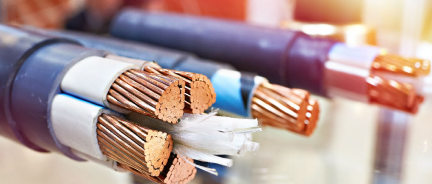
MI cable is listed for 2-hour fire resistance per UL 2196. It uses a copper or alloy sheath packed with magnesium oxide insulation, making it inherently fire-resistant. It is widely specified for emergency circuits in Type I/II construction when conduit wrapping is not preferred.
Emergency Power Circuits in Fire Pumps (600 V)
Recommended cable: XHHW-2
XHHW-2 is 90°C wet/dry rated at 600 V with strong moisture resistance and better performance in elevated ambient temperatures—especially relevant in fire pump rooms. It is available in large conductors needed for high-horsepower pump motors.
Generator Feeder & Transfer Switch Connections
Recommended cable: RHW-2 or XHHW-2 in rigid metal conduit (RMC)
These runs must be sized for full generator output and must meet wiring independence requirements. RMC provides strong mechanical protection and is required in many jurisdictions for the generator room feeder run. Where flexibility is needed at the generator connection, use Type W or a listed flexible assembly with THWN-2 conductors.
Unit Equipment (Battery Pack) Branch Circuits
Recommended cable: THHN/THWN-2, 12 AWG minimum
No special cable type is required beyond standard wiring methods, but the circuit must be run in a dedicated raceway separate from non-emergency branch wiring per 700.10(A). In concealed locations, NM-B is typically not acceptable for emergency circuits—use THHN in conduit or MC cable where permitted.
Emergency Communications & Fire Alarm Power
Recommended cable: FPLP for signal runs; THHN/THWN-2 for AC supply
Use FPLP for signal runs in air-handling spaces. Use THHN/THWN-2 for the 120 V AC supply circuit. Where survivability is required under NFPA 72 or Article 760, use CI-rated cables.
Outdoor Runs & Wet Locations
Recommended cable: USE-2 or RHW-2 for direct burial; XHHW-2 in PVC conduit in grade
USE-2 is listed for underground service entrance and direct burial without conduit. For conduit-in-grade routing, XHHW-2 in Schedule 40/80 PVC is common. For short flexible connections at the generator, use SOOW or Type W where listed and permitted.
Cable Comparison For Article 700 Applications
-
600 V; 90°C; wet location: yes (THWN-2); fire-rated: no
-
Best use: emergency lighting branch circuits, unit equipment feeds
-
600 V; 90°C wet/dry; wet location: yes; fire-rated: no
-
Best use: fire pump circuits, large feeder conductors, wet environments
-
600 V; 90°C wet; wet location: yes; fire-rated: no
-
Best use: generator feeders, transfer switch connections, rugged installations
-
MI Cable (Mineral Insulated)
-
600 V / 1 kV; wet location: yes; fire-rated: 2-hour (UL 2196)
-
Best use: fire-rated circuit protection per 700.10(D); healthcare, high-rise
-
CI Cable (Circuit Integrity)
-
typically up to 600 V; wet location: varies; fire-rated: commonly 2-hour (UL 2196)
-
Best use: fire alarm power circuits requiring survivability per NFPA 72
-
600 V; 90°C; wet location: yes; fire-rated: no
-
Best use: direct burial; outdoor generator feeder to building
-
2 kV / 600 V; 60–90°C; wet location: yes; fire-rated: no
-
Best use: flexible whip at generator terminal; outdoor wet connections
-
300 V (signal); 75°C; plenum use: yes; fire-rated survivability: no
-
Best use: fire alarm signal circuits in air-handling spaces
Final Checklist: Article 700 Compliance
-
Emergency source rated for full connected load, capable of 10-second pickup
-
Listed ATS is preventing simultaneous source connection
-
Selective coordination of all overcurrent devices on emergency circuits
-
Complete wiring independence from normal circuits (separate raceways, panels, boxes)
-
Fire-rated wiring protection in Type I/II construction where required
-
Emergency illumination ≥ 1 fc at floor level along all egress paths
-
Monthly 30-second functional test + annual full-load test; written records on premises
-
Supervisory signals at a continuously attended location
-
Required signs at the service entrance and all transfer equipment
-
No non-emergency loads on emergency branch circuits
All types of cables for emergency systems are available at Nassau National Cable.