Garrie AI: Your Cable Guide


12/2 vs 14/2 Wire: Which One Do You Actually Need?
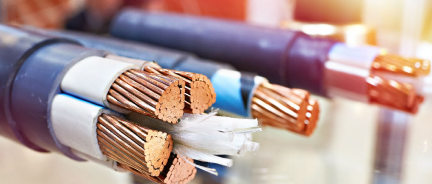
“12/2” and “14/2” are constantly compared because they are tied directly to the two most common residential circuit sizes: 20-amp and 15-amp circuits. A 12/2 NM-B Cable is used on 20-amp breakers, while a 14/2 NM-B Cable is limited to 15-amp breakers under the NEC. Both are NM-B cable — non-metallic-sheathed building wire designed for dry indoor residential wiring. Commonly called Romex on job sites, NM-B cable contains insulated conductors and a bare ground wire, wrapped in a flexible outer jacket, for branch circuits powering outlets, switches, and lighting.
This article breaks down what the numbers actually mean, where each cable belongs, when their applications overlap, and why choosing the wrong gauge can create both code violations and real safety problems. It also briefly examines how the same 12/2 and 14/2 sizing logic applies across other wiring methods, including MC cable, UF-B, and THHN conductors in conduit.
Breaking Down the Numbers
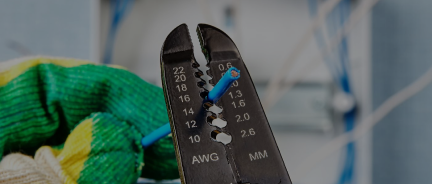
12/2: 12 AWG conductors (2.05 mm / 0.081 in diameter), two current-carrying conductors — black hot, white neutral — plus a bare copper ground. Rated for 20-amp circuits.
14/2: 14 AWG conductors (1.63 mm / 0.064 in diameter), same black-white-ground configuration. Rated for 15-amp circuits.

The ground isn't counted in the "/2" because it carries no current under normal conditions.
The "/2" designation is what distinguishes these cables from their "/3" counterparts. A 12/3, for example, carries three current-carrying conductors (black, red, white) plus a ground — used for 240V circuits, multi-wire branch circuits, and certain 3-way switch configurations. When you see "/2," you're always looking at a standard single-phase, two-conductor cable.
A "/3" cable adds a red conductor to the mix — that's what you'd pull for 240V circuits, multi-wire branch circuits, or certain 3-way switch configurations. "/2" is everything else: standard single-phase branch circuits.
Both cables come with a PVC jacket and THHN/THWN-2 inner insulation as NM-B. The jacket colour is standardised: 14/2 NM-B is white; 12/2 NM-B is yellow.
12/2 vs 14/2 Specific Applications
14/2 — Lighting and General Receptacles
14/2 is the right wire for circuits where the total draw stays well under 15 amps and nothing high-demand is connected:
-
Bedroom, hallway, and living room outlets
-
Light fixture circuits
-
Switched lighting — 14/2 handles single-pole and standard 3-way loops; if travellers need to run between two 3-way switches, that's 14/3
-
Ceiling fans — 14/2 works when one switch controls both fan and light; separate wall controls for each require 14/3 to the ceiling box
-
Bathroom lighting on a dedicated lighting circuit — receptacles are on a separate 20-amp circuit
12/2 — Kitchens, Baths, Appliances, and High-Load Circuits
12/2 is required wherever the NEC mandates a 20-amp circuit:
-
Kitchen small-appliance circuits — NEC 210.11(C)(1) requires a minimum of two 20A circuits
-
Bathroom receptacle circuits — NEC 210.11(C)(3)
-
Laundry circuits — NEC 210.11(C)(2)
-
Garage receptacles — NEC 210.52(G)
The NEC doesn't always mandate 20 amps for dedicated appliance circuits, but the loads involved make 12/2 the only practical choice for:
-
Dishwashers and disposals
-
Refrigerators and chest freezers
-
Workshop receptacles and tool circuits
-
EV charger circuits (Level 1; Level 2 typically requires 10 AWG or larger)
Overlap between 12/2 ansd 14/2 Applications
Despite the clean 15A/20A split, some circuit types don't fall neatly on either side. Many are technically permissible in either gauge, but with a clearly better answer in practice.
Basement and utility room receptacles. These aren't always NEC-mandated 20-amp circuits, but they're frequently used to power shop vacs, dehumidifiers, sump pump accessories, and power tools.
Refrigerators on general circuits. A refrigerator draws roughly 3–6 amps running, with startup surges up to 15. It can run on a 15-amp circuit and sometimes does, but a dedicated 20-amp circuit on 12/2 is the recommended approach, especially if the circuit will ever share load with anything else.
Home office receptacles. A circuit powering a desk, monitors, and peripherals can easily stay under 15 amps, making it code-compliant with 14/2. Add a space heater or a workstation with a dedicated GPU, and that calculus changes fast. In a purpose-built home office, 12/2 on a 20-amp circuit is the more defensible choice because the total equipment can easily exceed 15 amps.
Switched receptacles. If a wall switch controls an outlet used for lamps, 14/2 is standard. If that outlet might eventually power something heavier, or if it's adjacent to a kitchen or workspace, 12/2 gives you the flexibility without rewiring.
Outdoor receptacles. NEC 210.52(E) requires at least one outdoor receptacle at the front and back of a dwelling. The code doesn't mandate 20 amps for all outdoor outlets, but most inspectors and contractors default to 12/2 because outdoor circuits often power pressure washers, compressors, and seasonal equipment.
In all of these cases, 12/2 on a 20-amp breaker is the conservative professional default — not because the code demands it, but because the cost of rewiring later is higher than the cost of upgrading at install.
Cost: Specific Numbers
Wire pricing moves with copper, but at typical distributor pricing in 2024–2025:
-
14/2 NM-B: approximately $0.30–$0.45 per foot
-
12/2 NM-B: approximately $0.45–$0.65 per foot
On a single 50-foot circuit run, the difference is roughly $5–$15. Across a full residential rewire with 20+ circuits averaging 75 feet each, that gap becomes $150–$300 in materials, which is real money but not enough to justify running the wrong gauge on any circuit that calls for 12/2.
12/2 and 14/2 Beyond Romex
The /2 designation and AWG logic aren't specific to NM-B — they apply across wiring methods. Each cable type has its own size range, and the 12/2 and 14/2 configurations sit in the middle of a broader spectrum in each case.
MC Cable (Metal-Clad) is the standard branch-circuit cable in commercial and light industrial construction where NM-B isn't permitted. It's available from 14 AWG through 1000 kcmil for large feeder applications. In branch-circuit sizes, 14/2 and 12/2 are the standard configurations for 15A and 20A circuits, respectively. 10/2 MC handles 30A dedicated circuits, such as water heaters, HVAC equipment, and EV chargers. The /3 variants (12/3, 10/3) cover multi-wire branch circuits and 240V loads. For larger feeder runs to subpanels or distribution equipment, MC scales up through 8, 6, 4, 2, and 1 AWG in both /2 and /3 configurations.
UF-B (Underground Feeder) runs from 14 AWG through 4/0 AWG. At the branch circuit end, 14/2 covers 15A outdoor lighting runs and low-draw landscape circuits; 12/2 handles 20A outdoor receptacles and outbuilding circuits. Step up to 10/3 UF-B, and you're feeding a 30A subpanel in a detached garage. Larger underground feeds to outbuildings or accessory structures typically move to 6/3 or 4/3, and at that point, conduit with THHN is often the more practical alternative.
THHN/THWN-2 in conduit covers the widest size range of any wiring method, from 14 AWG at the small end up through 2000 kcmil for service entrance conductors. At the branch circuit scale, 14 AWG and 12 AWG are pulled in pairs (hot and neutral) with a separate ground, which is functionally equivalent to a /2 cable, just not bundled.
Where Cable Types Overlap in Application
Several locations allow more than one wiring method, meaning the cable type decision is a separate judgment call from the gauge decision.
NM-B vs. MC — dry, concealed residential locations. In most jurisdictions, both are code-compliant for concealed runs inside finished walls and ceilings. Contractors sometimes choose MC for exposed basement or garage runs even where NM-B would pass inspection — the armor handles incidental contact better. In Chicago and New York City, NM-B is not permitted at all; MC or conduit is required throughout, including in single-family homes.
MC vs. THHN in conduit — commercial construction. Both are standard in light commercial work. MC installs faster since there's no conduit to run, but THHN in conduit wins on long-term serviceability: individual conductors can be pulled and replaced without touching the cable assembly. In wet or corrosive locations, conduit with THHN is often the cleaner solution because MC's wet-location ratings vary by product and require closer attention at spec time.
UF-B vs. THHN in conduit — underground outdoor runs. Direct burial is where these two overlap most directly. UF-B is simpler to install — no conduit required, just the right burial depth (typically 24 inches, or 12 inches with GFCI protection under NEC 300.5). THHN pulled through Schedule 40 PVC conduit is also code-compliant for underground runs at shallower depths (18 inches) and is generally preferred when future serviceability is a concern, since individual conductors can be replaced without excavation.
NM-B vs. UF-B — damp indoor locations. UF-B is rated for wet and damp locations; NM-B is not. In crawl spaces, unfinished basements with moisture exposure, or runs passing through concrete, UF-B is the appropriate choice even indoors. The cables are structurally similar enough that the wrong one occasionally gets installed — NM-B in a location that needed UF-B — which is worth flagging during inspection.
Quick Reference: 14/2 vs. 12/2 NM-B

Nassau National Cable supplies 14/2 NM-B, 12/2 NM-B, 10/2 NM-B, 14/3 NM-B, 12/3 NM-B, 14/2 MC, 12/2 MC, 14/3 MC, 12/3 MC, 14/2 UF-B, 12/2 UF-B, 10/2 UF-B, 12/3 UF-B, 6/3 UF-B, 14 AWG THHN, and 12 AWG THHN — in full reels and custom cut lengths for residential, commercial, and contractor applications. Contact us for volume pricing.