Garrie AI: Your Cable Guide


A Guide To Mobile Home Electrical Wiring
Mobile home electrical wiring has a few requirements that set it apart from conventional residential wiring, including outdoor service equipment, four-wire feeders, and outlets and switches designed for thinner walls. NEC Article 550 covers these installations.
This guide covers mobile home service connections, 100-amp and 200-amp feeder sizing, wiring diagrams, outlets, light switches, and cable selection.
NEC Article 550 Rules for Mobile Home Feeder Wiring
According to NEC Article 550 on mobile home feeders:
-
Service equipment must generally be located outside the mobile home, within sight and no more than 50 ft away.
-
Manufactured homes on permanent foundations may qualify for an exception allowing service equipment inside or on the home.
-
Mobile home service equipment must have a minimum rating of 100 A at 120/240 V.
-
Permanent feeders must have four insulated conductors: two hot wires, one neutral, and one equipment ground.
-
Homes with smaller electrical loads may qualify for a listed 50 A, four-conductor cord connection.
-
The neutral and ground must remain separate inside the mobile home's electrical panel.
-
A standard SER cable with a bare ground does not meet the insulated-grounding-conductor requirement, but a compliant four-conductor MHF cable can be used.
-
The 2026 NEC requires surge protection when existing service equipment is reused for a replacement home.
How to Run Electricity From the Pole to a Mobile Home
In a typical mobile home electrical setup, power runs from the utility pole to an outdoor meter and service disconnect, then through a four-wire feeder to the electrical panel inside the home.
Here are the steps to run the power:
-
Pull the permit and call the utility. The utility sets the meter location, the meter base specification and the service point. The AHJ confirms which NEC edition applies.
-
Set the pole or pedestal within sight of the home. Under 550.32(A) in the 2023 NEC, the service equipment stays off the home and within sight of it, which means visible and no more than 50 ft away. The 2020 NEC and earlier editions set a 30-ft limit, and some utilities and jurisdictions still apply it, so confirm the local rule.
-
Mount the meter base and service disconnect. The equipment is rated at least 100 A at 120/240 V. The outdoor disconnect sits at least 2 ft above finished grade.
-
Build the grounding electrode system. Bond the neutral and ground at the service disconnect only. Drive ground rods per Article 250; a single rod needs a supplemental electrode unless it meets the 25-ohm provision in 250.53(A)(2).
-
Trench to Table 300.5 depth. Direct-burial cable needs 24 in. of cover. Conductors in PVC conduit need 18 in. Rigid metal conduit needs 6 in.
-
Sleeve the riser at both ends. Conduit protects the cable from the minimum burial depth up to the termination point above grade per 300.5(D)(1). A slack loop or expansion fitting absorbs soil settlement and frost movement.
-
Pull the four-wire feeder. Two hot conductors, an insulated neutral, and an insulated EGC run as a single mobile home feeder cable.
-
Terminate at the home panel. The neutral lands on an isolated neutral bar. The EGC lands on the ground bar bonded to the enclosure. Remove any factory bonding screw or strap from the neutral bar.
-
Schedule the inspection. The utility energizes the meter only after the AHJ signs off.
Mobile Home Feeder Wire Size for 100 Amp and 200 Amp Service
The two most popular mobile feeders are 100-amp and 200-amp. A 100-amp mobile home feeder uses 2 AWG aluminium or 4 AWG copper phase conductors. A 200-amp feeder uses 4/0 aluminium or 2/0 copper. Both sizes come from NEC 310.12, which permits conductors sized at 83% of the rating when the feeder carries the entire load of a single dwelling.
Mobile home feeder (MHF) cable is labelled phase-phase-neutral-ground. In 2-2-2-4, the two hots and the neutral are 2 AWG aluminum and the insulated EGC is 4 AWG aluminum.
Mobile Home Feeder Wire Size Chart: 100 A, 150 A and 200 A Service

Reduced vs. full-size neutral. A smaller neutral conductor can reduce cable cost and weight because it carries only the unbalanced portion of the home's 120 V load. However, a load calculation under NEC 220.61 (120.61 in the 2026 NEC) must confirm that the smaller conductor can safely carry the expected neutral current.
Long runs. Longer feeder runs may require larger conductors to limit voltage drop. The NEC recommends keeping feeder voltage drop to 3% or less, so check the run length before selecting a cable size.
NEC 310.12. The 83% sizing rule applies to feeders supplying the entire dwelling load. Feeders serving only part of the home must follow standard ampacity requirements.
Mobile Home Wiring Diagram

A mobile home wiring diagram shows the location of the electrical panel, outlets, switches, lights, and circuits throughout the home. Circuit labels identify the breakers serving each area.
The diagram shows the main electrical panel, GFCI-protected outlets in areas such as kitchens and bathrooms, and the circuits serving different rooms. In double-wide mobile homes, wiring that crosses the marriage line between sections uses designated crossover connections that must remain accessible.
The circuit tags on the diagram match the panel directory. Article 550.12 requires separate circuits for lighting, small-appliance receptacles, laundry and each fixed appliance. The example panel schedule below matches the diagram:
|
1 |
General lighting |
15 A |
120 V |
|
2 |
Bedroom and living room receptacles, AFCI |
15 A or 20 A |
120 V |
|
3, 4 |
Small-appliance receptacles, kitchen and dining |
20 A each |
120 V |
|
5 |
Laundry receptacle |
20 A |
120 V |
|
6 |
Bathroom receptacles |
20 A |
120 V |
|
7-9 |
Electric range |
50 A |
240 V |
|
8-10 |
Electric dryer |
30 A |
240 V |
|
11-13 |
Electric water heater |
30 A |
240 V |
|
12-14 |
Electric furnace (down-flow, closet-mounted) or heat pump air handler |
Per nameplate |
240 V |
|
15 |
Dishwasher, GFCI |
15 A or 20 A |
120 V |
Mobile Home Outlets and Light Switches
Many mobile homes use self-contained outlets and switches that mount directly to thin wall panelling without a separate electrical box. These devices use insulation-piercing contacts that can loosen over time, causing flickering lights, warm outlets, or intermittent power.
Replacement Options
Self-contained mobile home outlets and switches can be replaced in two ways:
-
With a same-type device. Install a listed self-contained replacement compatible with the existing wiring and wall construction.
-
With an old-work box with a standard device: Install a suitable electrical box and a conventional outlet or switch with screw terminals.
Standard outlets and switches cannot be installed without an approved electrical box.
Aluminum Wiring and Electrical Protection
Older mobile homes may have aluminum branch-circuit wiring, which requires compatible devices or listed aluminium-to-copper connectors. Copper-only devices must not be connected directly to aluminum conductors.
Under NEC 406.4(D), replacement receptacles must have GFCI or AFCI protection where required by the applicable code. Have a qualified electrician check the wiring, device compatibility, and protection requirements before replacement.
How to replace a mobile home light switch
-
Switch off the breaker and lock or tag the panel.
-
Confirm the circuit is dead with a non-contact tester, then with a two-lead voltage tester at the device.
-
Remove the cover plate and the device mounting screws or clamps.
-
Photograph the conductor positions. A single-pole switch carries one cable in and one out. A 3-way switch has a common terminal and two travellers.
-
Identify the conductor material and size: 14 AWG copper for 15 A circuits, 12 AWG copper for 20 A circuits.
-
Install a same-type self-contained switch, or an old-work box with a standard switch.
-
Tighten every terminal to the torque specified by the device manufacturer, refit the plate, and restore power.
-
Test the switch and any downstream outlets.
The same sequence applies to a mobile home outlet replacement, with the GFCI and AFCI checks above added before step 6.
Cables Used in a Mobile Home
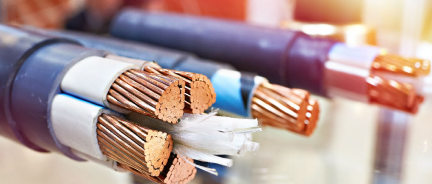
Mobile home feeder (MHF) cable is the primary power supply cable for a mobile home, connecting the outdoor service equipment to the home's electrical panel. It typically has four insulated aluminum conductors: two hot wires, a neutral, and an equipment ground.
Other cable types serve different parts of the electrical system, including NM-B for interior wiring, UF-B for damp or wet locations, THWN-2 or XHHW-2 for conduit runs, and low-voltage cables for HVAC controls and communications.
MHF is the default because it's specifically designed for mobile home feeders. It combines four insulated, colour-coded conductors into a single assembly and is rated for direct burial, wet locations, and connections to the home's panel. There's less need to verify multiple specifications or assemble individual conductors.
There are three alternative cables for mobile home feeders:
-
URD quadruplex: A cheaper alternative for underground runs. To serve as a mobile home feeder, it needs four individually insulated, properly identified conductors, including an insulated equipment ground (NEC 550.33). Its insulation ratings must also permit the installation. Note that USE-2-only conductors cannot extend into the home's interior. URD cable needs an additional RHH/RHW-2 rating for that. MHF is still a designated cable for underground runs that easily extend into the home interior. The reason to use URDs is merely a price.
-
THWN-2 or XHHW-2: Individual THWN-2 or XHHW-2 conductors are alternatives when an existing conduit system or custom conductor sizing makes them more practical.
The table below shows common mobile home cable types, their applications, and typical sizes.
|
Service feeder, pole to panel |
Aluminum MHF, four insulated conductors |
2-2-2-4 (100 A), 4/0-4/0-2/0-4 (200 A) |
550.33(A), 310.12 |
|
|
Feeder in conduit or to a pedestal |
Aluminum URD quadruplex, or single XHHW-2 / THWN-2 conductors |
2-2-2-4, 4/0 |
Table 300.5 |
|
|
Lighting and receptacle circuits |
NM-B copper with ground |
14/2 (15 A), 12/2 (20 A) |
334.10, 334.80 |
|
|
Water heater, dryer, range |
NM-B copper with ground |
10/2 (30 A water heater), 10/3 (30 A dryer), 8/3 (40 A range), 6/3 (50 A range) |
334.80 |
|
|
Underfloor runs exposed to moisture, outdoor circuits, sheds, well pumps |
UF-B copper with ground |
12/2, 10/2, 6/3 |
334.12(B)(4), Article 340 |
|
|
Conduit runs, exterior AC disconnect |
THWN-2 copper or aluminum building wire |
10 AWG to 4/0 |
Chapter 3 raceway articles |
|
|
Thermostat and HVAC controls |
Thermostat wire |
18/5, 18/8 |
Article 725 |
|
|
Internet, TV and security |
Cat6, RG6 coax, alarm cable |
Cat6 UTP, RG6 |
Article 800 series |
Note: NM-B is for dry locations only. NEC 334.12(B)(4) prohibits NM-B in damp or wet locations. Wiring exposed to moisture beneath a mobile home requires a suitable wet-rated cable, such as UF-B, or wet-rated conductors installed in an appropriate raceway.
Mobile Home Electrical FAQ
What size wire is needed for a 100-amp mobile home feeder?
2 AWG aluminium or 4 AWG copper for the phase conductors under NEC 310.12 when the feeder supplies the entire home. The most common assembly is 2-2-2-4 aluminum MHF cable.
What size feeder cable does a 200-amp mobile home service require?
4/0 aluminum or 2/0 copper phase conductors. 4/0-4/0-2/0-4 and 4/0-4/0-4/0-2/0 aluminum MHF both serve 200 A.
Can SER cable feed a mobile home? Not when it has bare ground. Article 550 requires four insulated conductors, so the EGC needs its own insulation.
How far can the meter pole sit from a mobile home?
Within sight of the home. The 2023 and 2026 NEC define that as visible and no more than 50 ft away. The 2020 NEC and earlier set the limit at 30 ft, and some utilities and jurisdictions still require it.
How deep does mobile home feeder cable get buried?
24 in for direct-burial cable and 18 in inside PVC conduit, per NEC Table 300.5.
Can a regular light switch go in a mobile home?
Yes, inside a box. A standard switch or outlet requires an old-work box; a self-contained mobile home switch mounts directly.
Nassau National Cable stocks every common mobile home feeder size and cuts it to the footage required for the job. Inventory ships from four U.S. warehouse locations, with standard 250 ft, 500 ft, and 1,000 ft reels or custom-cut lengths.
-
Aluminum Mobile Home Feeder Cable: 2-2-2-4, 2-2-4-6, 2/0 and 4/0 MHF assemblies with four insulated conductor
-
12/2 NM-B with Ground for 20 A branch circuits
For park-wide projects or multiple home sets, request a 15-minute quote or call 1-516-482-6313.
Сables Featured In This Blog

- Sale price
- $2.09
- Regular price
- $2.09
- Sale price
- $1.79
- Regular price
- $1.79
- Sale price
- $3.29
- Regular price
- $3.29
- Sale price
- $3.89
- Regular price
- $3.89
- Sale price
- $4.54
- Regular price
- $4.54
- Sale price
- $5.39
- Regular price
- $5.39