Garrie AI: Your Cable Guide


PVC vs. Metal Conduit: How to Choose for Electrical Projects
Electrical Projects
PVC and metal are two types of electrical conduit used in most electrical projects. This guide explains what each conduit type does, where it belongs, which cables it supports, and how contractors actually choose between them.
What Is Electrical Conduit?
Electrical conduit is a raceway designed to protect conductors from mechanical damage, moisture, and chemical exposure. The material you select influences not only code compliance, but also installation labor, long-term durability, and overall project cost.
In U.S. electrical construction, two conduit categories dominate:
-
PVC (nonmetallic conduit)
-
Metal conduit (RMC, IMC, EMT)
PVC Conduit (Rigid Nonmetallic Conduit – RNC)
PVC conduit is manufactured from thermoplastic polyvinyl chloride and is typically available in Schedule 40 for standard installations and Schedule 80 for areas requiring additional wall thickness. It is assembled using solvent cement, creating a continuous, sealed raceway. This type of conduit is also known as rigid nonmetallic conduit (RNC), which, in practice, is the same thing.
Advantages of PVC Conduit
PVC conduit is widely used because it is relatively cheap and durable in environments with potential corrosion.
-
Lower material cost makes PVC the default choice for large-scale underground and utility projects, where conduit footage can reach thousands of feet.
-
Corrosion resistance allows PVC to perform reliably in wet, coastal, and chemically aggressive environments where metal conduit would degrade over time.
-
Lightweight construction makes PVC easy to handle and labour-intensive.
-
Direct burial means no additional protective systems, so PVC is used for underground distribution and residential service runs.
-
Chemical resistance makes it suitable for wastewater facilities, industrial plants, and agricultural environments where exposure to corrosive substances is common.
-
Electrical isolation prevents unintended grounding paths, which can be beneficial in systems where grounding must be controlled and designed explicitly.
Limitations of PVC Conduit
PVC’s limitations are primarily related to mechanical strength and temperature performance.
-
Lower impact resistance means it can crack or deform under physical stress, making it less suitable for exposed or high-traffic areas.
-
Thermal expansion and contraction require careful design, including the use of expansion fittings, particularly in long outdoor runs.
-
Temperature limitations (≈75°C) restrict its use near heat sources such as generators or industrial equipment.
-
No inherent grounding capability requires the installation of a separate equipment grounding conductor, increasing the conductor count.
-
UV degradation over time can weaken exposed conduit if not properly rated or protected.
Metal Conduit (RMC, IMC, EMT)
Metal conduit systems are constructed from steel or aluminum and include three primary types: RMC (rigid metal conduit), IMC (intermediate metal conduit), and EMT (electrical metallic tubing). RMC is the heaviest-duty, IMC is slightly thinner, and EMT (thin-wall) is the lightest and most common in commercial work. They are joined with threaded couplings (RMC/IMC) or set-screw/compression fittings (EMT).
Advantages of Metal Conduit
Metal conduit performs better in demanding environments with heavy physical impact and high heat.
-
High mechanical strength provides superior protection against physical damage, making it suitable for exposed installations, industrial facilities, and areas with heavy equipment movement.
-
Integrated grounding capability allows the conduit itself to serve as the equipment grounding conductor.
-
High-temperature tolerance enables use in environments where heat buildup or ambient temperatures exceed PVC limits.
-
Fire resistance makes metal conduit appropriate for fire-rated installations in mission-critical environments.
-
Eliminating the separate EGC helps reduce conduit size
Commercial and industrial metal conduit systems routinely outlast their first major renovation. The conduit gets reused, with only the conductors being replaced.
Limitations of Metal Conduit
Despite its strengths, metal conduit introduces cost and installation complexity.
-
Higher material cost, especially in large-scale installations.
-
Heavier weight makes transportation and installation more labour-intensive compared to PVC.
-
Corrosion risk requires coatings in wet or chemical environments.
-
Labour-intensive installation involves bending, threading, and ensuring proper bonding continuity.
-
There are also material compatibility issues, such as aluminum reacting with concrete, which limits where certain types can be used.
Where Each Conduit Type Is Used
No single conduit type is appropriate for every application. In practice, contractors and engineers select conduit based on exposure conditions, code requirements, and total installed cost rather than relying on a single system across the entire project.
Underground and Direct Burial
Best choice: PVC conduit (Schedule 40 or 80)
PVC conduit is the standard choice for underground installations because it is inherently corrosion-resistant and approved for direct burial. In residential and light commercial projects, it is typically installed at a minimum depth of 18 inches to protect conductors from environmental exposure and physical damage. Metal conduit is generally avoided in these conditions due to its susceptibility to corrosion and higher cost unless specific protection requirements justify its use.
Commercial Interior Wiring
Best choice: EMT (Electrical Metallic Tubing)
EMT is the dominant conduit in commercial interiors because it balances cost, installation speed, and performance. It is lightweight, which allows electricians to bend and install conduit quickly on-site, while its ability to serve as the equipment grounding conductor eliminates the need for an additional grounding wire. This combination reduces both labour and material requirements across large commercial buildings.
Industrial and Hazardous Locations
Best choice: RMC or IMC
In classified environments such as Class I, II, and III locations, metal conduit, specifically RMC or IMC, is required because it provides a sealed, mechanically robust system that can contain sparks or arcs. Threaded joints and sealing fittings prevent flammable gases or dust from entering or escaping the raceway, which is critical for maintaining safety and code compliance in these environments.
Exposed Outdoor Runs
Best choice: Condition-dependent (PVC Schedule 80 or RMC)
The choice between PVC and metal conduit for outdoor use depends on the level of exposure. In corrosive environments such as coastal areas or wastewater facilities, Schedule 80 PVC is preferred because it will not degrade from chemical or salt exposure. However, in areas where conduit is likely to be struck or damaged, such as parking structures or loading docks, RMC is used for its superior mechanical strength.
Solar and Utility-Scale Projects
Best choice: Mixed system (PVC/HDPE underground + metal above ground)
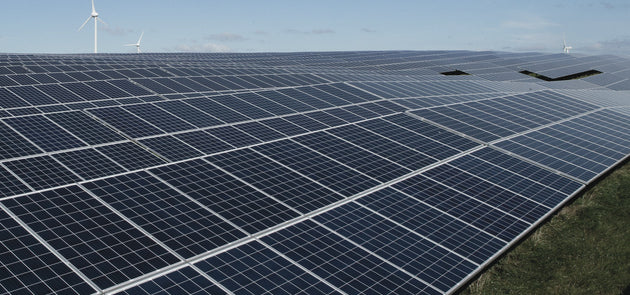
Utility-scale solar and energy projects typically use a combination of conduit types. PVC or HDPE is used for underground runs because of its cost efficiency and suitability for long-distance trenching. In contrast, metal conduit is used above ground where mechanical protection is required at equipment connections, inverters, and switchgear. This mixed approach balances cost with durability.
Data Centers
Best choice: EMT + RMC combination
Data centers rely on both EMT and RMC to meet performance and reliability requirements. EMT is commonly used for overhead and underfloor feeder distribution because it is easy to install and reduces conductor count through its grounding capability. RMC is used at service entrances, switchgear rooms, and other critical infrastructure points where additional mechanical protection and fire resistance are required.
Concrete Encasement (Duct Banks)
Best choice: PVC Schedule 40
PVC Schedule 40 is the standard choice for conduit embedded in concrete duct banks. It is compatible with the alkaline environment of concrete and provides a cost-effective solution for protecting underground feeders. Aluminium conduit cannot be used in this application because it reacts chemically with concrete, causing deterioration.
High-Temperature Environments
Best choice: Metal conduit (RMC or IMC)
Metal conduit is the only viable option in high-temperature environments because PVC has a maximum continuous operating temperature of approximately 75°C. In areas such as generator rooms, industrial plants, or near furnaces, metal conduit ensures both structural integrity and compliance with temperature ratings.

The U.S. Conduit Market in Numbers
Metal conduit holds the largest share of installed value in commercial and industrial projects, while PVC dominates by volume due to underground and residential applications. Here are the numbers as per 360 Research Reports, Credence Research, and Grand View Research.
-
41.8% — EMT share of metal conduit configurations.
-
62% — Plastic conduit share of global installations by volume
-
$1.72B — U.S. electrical conduit market size
-
+15pp — PVC market share growth over five years
-
33% — Residential share of PVC conduit usage
-
6.7% — Global conduit market CAGR
Growth is driven by infrastructure spending, electrification, and clean energy expansion. Utility-scale solar and EV charging projects rely heavily on underground conduit systems, where PVC is the default specification. NEVI-funded EV charging corridors require underground conduit runs at every installation point, and solar collection systems depend on concrete-encased PVC duct banks for primary distribution circuits. This is why the non-metallic segment is the fastest-growing in the U.S. market.
Cables Used With Each Conduit Type
Conduit type constrains conductor selection based on temperature rating, environment, and grounding requirements.
PVC Conduit — Common Conductors
-
THWN-2 / THHN — the default 90°C wet/dry conductor for most installations. Nylon-jacketed, pulls easily through solvent-cemented joints. Most common size range on commercial projects: #12 AWG through 500 kcmil.
-
XHHW-2 — for underground and moisture-heavy environments. Common in utility and EPC specifications for large underground feeders.
-
URD —aluminum conductors with XLPE insulation and a neutral wrap for residential underground distribution systems, primarily secondary distribution.
-
USE-2 / RHW-2 — the default for solar and service entrance applications, as well as combiner wiring in underground PVC conduit. Rated 90°C wet, sunlight resistant when listed — a key requirement on above-grade transitions at combiner boxes.
-
MV-105 — used in medium-voltage duct bank systems and utility and industrial distribution cable for runs above 600V. In concrete-encased PVC duct banks, it is the standard configuration for primary distribution circuits on large commercial and utility-scale sites.
Metal Conduit — Common Conductors
-
THHN / THWN-2 — standard conductors for EMT, IMC, and RMC. In EMT, the dry-location THHN rating applies to interior commercial wiring. The key difference is that in a metal conduit, no separate EGC is needed when fittings maintain continuity.
-
XHHW-2 — used in large industrial feeders with RMC or IMC conduit. XLPE insulation handles higher temperatures well.
-
Type MC cable — used alongside EMT for branch circuits. MC cable isn't pulled through conduit; it has its own interlocked armour, but it can be used alongside EMT in most commercial buildings. EMT handles feeders; MC handles final branch circuit drops to devices and fixtures where flexibility is needed.
-
THHW / RHH / RHW — used in high-temperature environments with RMC (generators, industrial ovens)
-
Tray cable (TC, ITC) — used in industrial and hazardous locations with RMC or IMC. Tray cable (NEC Article 336) and instrumentation tray cable (ITC, Article 727) may enter RMC at classified location boundaries via sealing fittings per NEC 501.15.
NEC Requirements for PVC and Metal Conduit
Article 352 — Rigid PVC Conduit (RNC)
Permitted for use in underground installations, concealed in walls/ceilings/floors, and in corrosive environments. Not permitted where subject to physical damage (unless Schedule 80), in areas of high ambient temperature exceeding conduit rating, or for support of luminaires unless listed for the purpose. Requires expansion fittings where temperature variation exceeds the guidance in 352.44, approximately one fitting per 100 ft of straight run in outdoor applications.
Article 358 — Electrical Metallic Tubing (EMT)
Permitted in both exposed and concealed locations. Not permitted where subject to severe physical damage, in cinder fill, in severely corrosive environments, or where protected from corrosion solely by enamel. EMT qualifies as an equipment grounding conductor under Article 250 when fittings maintain electrical continuity — eliminating the need for a separate EGC in many commercial wiring methods.
Article 344 — Rigid Metal Conduit (RMC)
The most broadly permitted conduit type in the NEC. Approved for all atmospheric conditions and occupancies, underground, in concrete, and in all hazardous locations. Aluminium RMC cannot be used in concrete or where in contact with earth unless supplemented by corrosion protection. Threaded joints must engage at least 5 full threads.
Article 250 — Equipment Grounding
Metal conduit systems (EMT, IMC, RMC) may serve as the equipment grounding conductor when installed with listed fittings, maintaining bonding continuity. PVC conduit installations require a separate equipment grounding conductor sized in accordance with Table 250.122. This distinction significantly affects wire quantities and conduit fill calculations on large projects.
Installation Tips
-
PVC expands approximately 3/8" per 10°F per 100 ft, requiring expansion couplings
-
EMT must be bent to the proper radius to maintain structural and grounding integrity
-
RMC requires properly threaded joints to ensure bonding continuity
-
Burial depth typically ranges from 12" to 24" for PVC installations
-
Conduit fill must not exceed 40% for systems with three or more conductors
-
Corrosive environments require proper material selection to prevent premature failure. In wastewater, coastal, or chemical plants: PVC Schedule 80 or fibreglass-reinforced conduit. Standard galvanised RMC will corrode in these conditions.
-
Never use aluminum conduit in concrete. Alkali in Portland cement attacks aluminum. Use PVC or hot-dip galvanised RMC instead
Case Studies
Here are actual examples of how different types of metallic and PVC conduit are used in real-life large electrical projects:
Municipal water treatment plant, Gulf Coast
Conditions include:
-
Corrosive environment
-
Outdoor exposed
-
Chlorine + salt air
Schedule 80 PVC was used for outdoor runs due to corrosion from chlorine and salt air, while EMT was used indoors.
The project team specified Schedule 80 PVC for all outdoor feeder runs at a municipal wastewater treatment facility in a coastal county. The combination of chlorine off-gassing and salt-laden marine air would have caused standard galvanised RMC to deteriorate within 5–7 yearsю
PVC Sch. 80 was selected for its corrosion immunity, with PVC-coated LT fittings at every equipment connection. Conduit expansion joints were installed every 80 ft. on straight outdoor runs. Interior MCC wiring used EMT throughout, taking advantage of its equipment-grounding functionality within the climate-controlled building. Conductors throughout were THWN-2, with XHHW-2 on longer outdoor feeder runs for additional moisture resistance.
High-Rise Office Tower (Chicago)
-
High-rise construction
-
Commercial interior
EMT was used throughout the interior systems to reduce weight and eliminate grounding conductors, while RMC was used at service entry points.
A 40-story commercial tower used EMT exclusively for all branch circuits and feeder wiring above the ground floor. EMT's lighter weight reduced structural load across floor-by-floor conduit stacks, its equipment grounding capability eliminated an estimated 180,000 ft. of separate EGC conductors, and the local union workforce's speed with EMT bending reduced installation labour hours by roughly 12% compared to an RMC-equivalent scope. Ground-floor electrical room feeders and the main distribution switchgear room used RMC for impact protection and to meet the AHJ's preference for heavier-duty raceway at service-entrance equipment. THHN was used throughout interior dry locations; THWN-2 at all wet or damp-rated points.
Utility-Scale Solar Project (Texas)
-
Direct burial
-
Underground feeders
-
PVC duct bank
PVC duct banks were used underground for cost efficiency, with RMC used above ground for protection.
A 200 MW solar + BESS project in West Texas used PVC Schedule 40 in concrete-encased duct banks for all underground collection system cabling between combiner boxes and the substation, with runs averaging 1,500–4,000 ft. per circuit. PVC was the only viable specification: aluminium conduit is excluded from concrete applications, and an RMC-encased duct bank would have increased materials cost approximately 4× with no functional advantage underground. Above-grade inverter and switchgear connections used RMC at all points where vehicles or maintenance equipment could contact the raceway. Conductors were USE-2/RHW-2 on DC collection circuits and MV-105 EPR on the medium-voltage AC collection system.
Pharmaceutical Facility (New Jersey)
-
Class I Div. 2
-
Hazardous location
RMC was required throughout hazardous areas to meet NEC requirements for classified locations.
Production areas classified as Class I, Division 2 under NEC Article 501 require RMC throughout. PVC is not permitted in hazardous locations where ignition risk from arc or spark must be contained. Threaded RMC with explosion-proof fittings sealed the raceway system at every boundary point between classified and unclassified areas per NEC 501.15. Stainless steel RMC was selected over standard galvanised in active ingredient synthesis zones where aggressive solvent vapours and frequent acidic washdowns would compromise standard zinc coating within 18 months. Instrumentation tray cable (ITC) entered RMC runs at classified zone boundaries with listed sealing fittings.
When to Choose Which Conduit
-
Underground direct burial → PVC Schedule 40
-
Concrete duct bank → PVC Schedule 40
-
Commercial interiors → EMT
-
High-impact exposed areas → RMC
-
Hazardous locations → RMC / IMC
-
Corrosive environments → PVC Schedule 80
-
Outdoor feeder runs with temp swings → both, depending on conditions. PVC viable with expansion joints; EMT or RMC if physical damage risk is elevated.
-
Fire-rated assemblies → EMT / RMC
-
Solar underground systems → PVC Sch. 40
-
Budget residential projects → PVC Sch. 40
The instinct to default to a single conduit type across an entire project is a cost risk in both directions; use different conduit types for different tasks. The best conduit type should match the specific conditions of each segment of the raceway system.
Nassau National Cable supplies both PVC and metal conduit, along with wire and cable, for commercial, industrial, and utility projects.