Garrie AI: Your Cable Guide


How to Wire a 24v Trolling Motor?
Wiring a 24-volt trolling motor correctly in series is essential for achieving full performance, protecting your equipment, and meeting ABYC and U.S. Coast Guard safety standards. This guide shows you exactly how to hook up a trolling motor to a battery when using a 24V motor, and how to choose the correct trolling motor wire size.
When and Why You Need a 24V Setup
If you’re using a trolling motor with 70 to 80 pounds of thrust, you’ll need a 24-volt system. These motors draw more power and are often used for:
-
Medium to large boats (16–20+ ft)
-
Boats used for fishing in the wind or strong currents
-
Boats that require extended battery life for all-day runtime and efficiency
A 24V trolling motor runs on two 12V deep-cycle marine batteries connected in series.
How to Wire Two 12V Batteries for a 24V Motor
To wire for 24 volts:
-
Connect Battery 1’s (+) to Battery 2’s (–) using a series jumper. This means connecting a jumper wire from the positive terminal of Battery 1 to the negative terminal of Battery 2. This is used to combine the two 12V sources into a single 24V output.
-
Connect the motor’s negative (–) lead to Battery 1’s (–) terminal to complete the negative side of the circuit.
-
Connect the motor’s positive (+) lead to Battery 2’s (+) terminal through a 60 amp circuit breaker to complete the circuit.
-
Note that the 60-amp breaker should be installed on the positive lead between Battery 2 (+) and the motor, as close to the battery as practical.
This gives you a full 24V output across the outer terminals of the battery series. Here is a trolling motor diagram that illustrates wiring in 24 24-volt trolling motor battery setup:

What Gauge Wire for Trolling Motor?
The recommendation below for 24 24-volt trolling motor battery setup aligns with ABYC E-11 standards. The size depends on the motor's maximum draw and the total length of the wire, with an acceptable voltage drop of up to 3%. The final choice depends on the motor's thrust rating
For 70 lb Thrust Motors (42 A max draw @ 24VDC):
-
Up to 15 ft: 8 gauge wire for trolling motor
-
20 ft: 6 AWG
-
25 ft: 4 AWG
-
Circuit breaker: 50 A
For 80 lb Thrust Motors (56 A max draw @ 24VDC):
-
Up to 5 ft: 8 AWG
-
10–15 ft: 6 AWG
-
20 ft: 4 AWG
-
25 ft: 2 AWG
-
Circuit breaker: 60 A
The same wire-sizing rules apply for 12V trolling motors, but since 12V systems draw more current than 24V systems for the same power, they require thicker wire over the same distances. For example, a 55 lb thrust 12V motor that draws up to 50 amps needs 4 AWG wire for a 15 ft run, while a 70 lb 24V motor drawing 42 amps can use 6 AWG for the same length. Always base your wire size on amp draw + wire length, using manufacturer charts to avoid overheating or voltage drop.
! Always round up in wire size (i.e., down in gauge number) if you’re close to the limit!
Safety Considerations For Trolling Motor Wiring
-
Do not use any type of extension wire for 30 lb thrust motors. These types of motors are optimised as portable units, and modifying the wire length may reduce performance.
-
Use only a manual reset, trip-free breaker or fuse.
-
Stay within a 3% voltage drop limit for best efficiency and compliance.
-
Support wire with cable clamps every 18–24 inches
-
For wire extension over 25 feet, immediately contact a marine technician.
-
Never combine more than 2 conductors together inside the conduit.
Recommended Cable Types for Trolling Motor Wiring
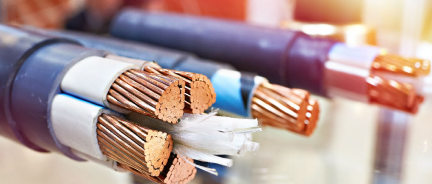
Use marine-grade tinned copper wire that resists corrosion and saltwater when wiring a 24-volt trolling motor. Household and automotive wire is not rated for marine use and may fail prematurely; any non-marine-grade wiring is prohibited in these environments. When choosing a cable, look for these Specs:
-
UL 1426 Marine Battery Cable
-
Flexible, fine-strand tinned copper
-
Rated for oil, fuel, water, and UV exposure
-
Marked as BC-5W2
-
Ancor marine battery cable is one of the most popular and universally trusted brand names for that type of cable.
-
SGX-Rated Cable
-
Thicker insulation, high-heat resistance (up to 125 °C)
-
Great for engine compartments or high-load applications, so can be used in bass boats, tournament fishing boats, dual-engine motorboats. In general, use it for any boat where the wiring passes through enclosed or high-load areas.
-
Any marine-grade wire you choose for a trolling boat must have 105 °C or higher insulation, along with oil/moisture / UV resistance. Always check the specs with the manufacturer.
-
Avoid using any residential wire that is not marine-grade and simple automotive primary wire like GPT.
-
Use the same cable type for series jumper, circuit breaker lead, and main motor leads.
Trolling Motor Wiring: Safety and Best Practices
-
Do not use any type of extension wire for 30 lb thrust motors. These types of motors are optimised for portable use, and changing the wire length may reduce performance.
-
Use only a manual reset, trip-free breaker or fuse.
-
Stay within a 3% voltage drop limit for best efficiency and compliance.
-
Support wire with cable clamps every 18–24 inches.
-
For wire extension over 25 feet, immediately contact a marine technician.
-
Never combine more than 2 conductors together inside of the conduit.
-
Use sealed ring terminals and marine heat shrink.
-
Use a duplex jacketed cable to make routing easy.
-
Trusted brands for marine wiring include Ancor, Pacer, Southwire Marine, and TEMCo.
-
Keep cable runs short and direct.
-
Use a matching-gauge series jumper wire between the batteries.
-
Always install a 60 A circuit breaker for 24V motors, and keep it close to Battery 2 (+).
-
Label both ends of each cable.
-
Disconnect power before charging.
-
Never share the trolling motor circuit with other electronics.
-
Apply dielectric grease on connections to prevent corrosion.
-
Keep battery terminals tight and protected.
-
Never connect the battery (+) and (–) together.
-
Make sure that no foreign metal object ever gets inside of the battery.
-
Ensure your motor is off before putting the propeller in water.
-
Use sealed ring terminals and heat-shrink tubing at all connections.
-
Any type of boat alteration must be performed by a marine technician with the qualifications to work on boats.
-
Not following wiring rules can lead to a battery explosion.
-
The battery has to be installed in a ventilated compartment.
Safety and Compliance Standards For Inspection (ABYC, USCG)
The trolling boat wiring should align with ABYC E-11 and 33 CFR 183, enforced by the U.S. Coast Guard, insurance providers, and marine inspectors. Correct wiring is necessary to pass the inspection. Circuit protection is legally required on all ungrounded conductors. Improper installations may lead to battery damage and risk of fire.
Inspectors often check for:
-
Properly sized circuit breakers or fuses
-
Clean, labelled battery terminals
-
Marine-grade wiring
-
ABYC-compliant materials and layout
Final Checklist for a Safe 24V Trolling Motor Wiring Setup
-
Two 12V deep-cycle marine batteries (Group 27 or 31)
-
Proper marine-grade wire sized per your motor & run length
-
A 60-amp manual-reset breaker
-
UL 1426 or SGX-rated cable with 105 °C insulation
-
ABYC-compliant install layout with no shared loads
-
Series jumper wire (same gauge as leads)
-
Labels, clamps, and sealed terminals throughout
Nassau National Cable is a trusted distributor of marine-grade cables, including SGX, Ancor marine battery cable, and UL 1426 cable from other brands.